Key Points
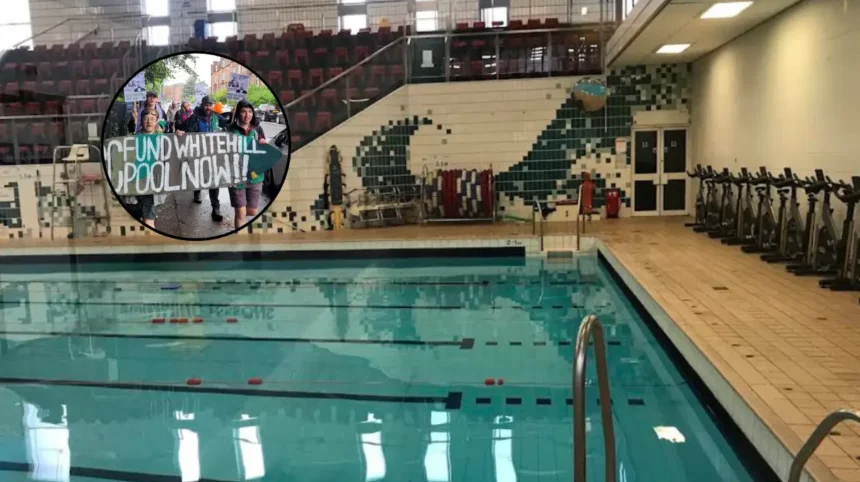
- Protest and Council Gatecrashing: East End residents, members of Living Rent Dennistoun, and the Save Whitehill Pool campaign group have staged demonstrations and entered Glasgow City Chambers to demand a definitive reopening plan for the facility.
- Closure Reason: Whitehill Swimming Pool in Dennistoun was shut down in December 2023 following the discovery of Reinforced Autoclaved Aerated Concrete (RAAC) in its roof structure.
- Controversial Proposals: Campaigners reacted with outrage after learning that Glasgow Life officers had considered recommending a “mothball or demolition” option to council officers.
- Impact on Local Swimming Club: The 40-year-old Whitehill Swimming Club has seen its membership halved following a five-mile relocation to an Easterhouse facility with restricted hours and shallow depth.
- Escalating Financial Costs: Reports indicate the pool required £18 million in general maintenance prior to the RAAC discovery, with complete roof replacement adding nearly £6 million to the total.
- Commonwealth Games Context: Whitehill Pool is set to be the only council-run pool remaining closed when Glasgow hosts the Commonwealth Games.
Glasgow (Glasgow Express) July 30, 2026 – Residents and community campaigners from Glasgow’s East End have mounted demonstrations demanding the immediate repair and reopening of Whitehill Swimming Pool. The facility, situated in Dennistoun, was shuttered in December 2023 after inspectors discovered structural hazards linked to Reinforced Autoclaved Aerated Concrete (RAAC) in its roof. Demonstrators have marched to the Glasgow City Chambers and gatecrashed council proceedings to oppose proposals that could lead to the site being demolished or mothballed. The protest comes as Glasgow prepares to host the Commonwealth Games, with Whitehill Pool currently standing as the sole council-run swimming facility in the city slated to remain closed during the international event.
- Key Points
- Why are Dennistoun residents protesting against Glasgow City Council?
- What statements were made by community campaigners and Living Rent?
- How has the closure impacted the 40-year-old Whitehill Swimming Club?
- What is the financial cost of repairing Whitehill Pool?
- How has Glasgow Life responded to the community’s demands?
- What is the background of the Whitehill Pool closure?
- How could this development affect local residents and the Commonwealth Games?
Why are Dennistoun residents protesting against Glasgow City Council?
Community frustration peaked after details emerged regarding potential options for the building’s future. Campaigners from Living Rent Dennistoun and the Save Whitehill Pool group reported being informed during a meeting with local leisure charity Glasgow Life that officers had considered recommending a “mothball/demolition” strategy to council administration.
Local residents argue that mothballing the venue would lead to structural decay and permanent abandonment, stripping the East End of vital health and recreational infrastructure.
Protesters assembled outside civic offices and entered council chambers holding placards and wearing swimming gear, demanding that municipal leaders commit to funding necessary structural repairs.
As reported by Josh Pizzuto-Pomaco of The Herald, Melissa Clifford, a representative of Living Rent Dennistoun, stated that
“Whitehill Pool and gym’s closure has impacted so many people in our local community, including myself and many of my friends”.
Clifford added that
“Overnight, we lost not just a pool to swim in and a gym to work out in, but the place where a lot of us kept up our routines and looked after our physical and mental health”.
Addressing the practical difficulties created by travelling to alternative sites across the city, Clifford explained that
“Going to other pools in the city is not a simple solution: by the time you’ve paid for a taxi, bus or train, the cost and time involved put it out of reach for many people on low incomes, parents with children or anyone with mobility issues”.
What statements were made by community campaigners and Living Rent?
Community leaders have framed the potential permanent loss of the facility as a neglect of East End neighborhoods by civic decision-makers.
As reported by Josh Pizzuto-Pomaco of The Herald, Jack Hanington, secretary for Living Rent Dennistoun, stated that
“For families in Dennistoun, closing this pool permanently is not an option. People need places where they can exercise, socialise and come together as a community, and Whitehill Pool has always provided that”.
Hanington further commented on the initial proposal from leisure officers, stating that
“Learning that Glasgow Life officers had intended to recommend a ‘mothball/demolition’ option represented a betrayal of all the work that had been done by community members. Once again, the families of Dennistoun are being left behind by the city administration”.
He urged authorities to re-align their priorities, adding that
“Now, Glasgow Life and Glasgow City Council must understand that their job is to serve the community, not make decisions behind our backs”.
Campaign organiser Bill Stark highlighted long-standing maintenance deficiencies prior to the emergency closure. As reported by STV News, Bill Stark stated that
“If the essential maintenance was carried out in a timely manner, we may not have been standing here today with this problem. That’s the frustration. At what point does Glasgow address these ageing pools?”
How has the closure impacted the 40-year-old Whitehill Swimming Club?
The prolonged closure has created substantial operational disruptions for local sports organisations, most notably the Whitehill Swimming Club, which has operated in the area for over four decades. Following the 2023 shutdown, the club was forced to relocate five miles away to an alternative facility in Easterhouse.
As reported by STV News, Craig Cunningham, Chairperson of Whitehill Swimming Club, stated that
“We feel like a club without a home. This pool is only one metre deep at both ends. We can’t do any diving there”.
Cunningham expressed concern over youth retention, adding that
“There are kids in the pool just now thinking of giving swimming up because they’re not happy about the situation we’ve got here, but we physically can’t do anything else”.
The combination of increased travel distance, reduced lane availability, and restricted timetable slots at the temporary venue has led to a 50 percent reduction in the club’s active membership. Despite these setbacks, the club was awarded the ‘Triumph over Adversity’ honor at the Club Sport Glasgow Annual Awards.
Parental perspective on the move was captured by local parent Linda Thompson. As reported by STV News, Linda Thompson stated that
“It’s been really challenging for the club, [and] really challenging for parents as well. We want to do our best and make sure our kids [are] learning life skills. With the closure of our local pool, it’s so much more difficult”.
What is the financial cost of repairing Whitehill Pool?
The financial burden required to restore the facility is a central factor in the debate surrounding its future. According to figures cited by STV News, Whitehill Pool required approximately £18 million in general upgrades and refurbishment to meet modern standards prior to the discovery of the defective concrete.
The subsequent detection of RAAC in the building’s roof structure introduced substantial added expenditure, with structural evaluations estimating that replacing the affected roof components will require an additional £6 million, bringing total prospective costs near £24 million.
Advocates point out a stark contrast in how nearby infrastructure was handled. When RAAC was identified in the roof of the adjacent Whitehill Secondary School in 2021, remedial works were funded and executed, allowing the school to remain operational. Conversely, the leisure facility remained empty and shuttered, with windows boarded up since late 2023.
Explore More Dennistoun News
Glasgow Council Tightens Crackdown on Advertising Blight in Dennistoun – 2026
Glasgow hostel extension plan targets 16 new rooms in Dennistoun 2026
How has Glasgow Life responded to the community’s demands?
Glasgow Life, the charitable trust responsible for managing culture and sport facilities on behalf of Glasgow City Council, has stated that no definitive decision has been made regarding total demolition.
As reported by Josh Pizzuto-Pomaco of The Herald, a spokesperson for Glasgow Life stated that
“We have not submitted a formal recommendation to Glasgow City Council as we are working closely with the Save Whitehill Pool group, which includes a representative of the Living Rent organisation, other community stakeholders, and local elected members to finalise the outline”.
The spokesperson clarified the allocation of responsibilities between the trust and municipal leaders, adding that
“The options that will be in the business case have been agreed in conjunction with all the stakeholders and will allow Glasgow City Council to consider potential approaches and associated costs for Whitehill Pool. Ultimately, it will be Glasgow City Council that makes the decision regarding the allocation of capital funding for any future refurbishment or development of Whitehill Pool”.
In a statement provided to STV News, a Glasgow Life spokesperson reiterated that
“Our priority is to provide Glasgow City Council with a comprehensive strategic and financial analysis of each option’s benefits and disadvantages, and it will be the council that makes the decision regarding the allocation of capital funding for any future iteration of Whitehill Pool”.
What is the background of the Whitehill Pool closure?
Whitehill Swimming Pool originally closed during the initial COVID-19 pandemic restrictions. Following a period of closure, it briefly reopened before being forced to shut its doors for a second time in December 2023. The second closure occurred after a visual inspection and subsequent engineering assessment confirmed the presence of Reinforced Autoclaved Aerated Concrete (RAAC) within the roof planks.
RAAC is a lightweight, bubbly form of concrete used widely in public building construction from the 1950s through the 1990s.
In recent years, structural experts identified that the material is prone to sudden structural failure and water ingress deterioration when exceeding its design lifespan, leading to nationwide closures of schools, hospitals, and public leisure complexes across Scotland and the wider United Kingdom.
While secondary education facilities sharing the site received council investment to replace affected RAAC materials, the swimming facility remained unallocated for immediate structural capital funding, leaving local swimming clubs and general public users redirected to facilities in Easterhouse, Tollcross, Springburn, and the Gorbals.
How could this development affect local residents and the Commonwealth Games?
The ongoing impasse over Whitehill Pool has direct implications for several distinct groups across Glasgow:
- Impact on Dennistoun Residents and Low-Income Families: The prolonged absence of a neighborhood pool increases healthcare and travel burdens. Residents in lower-income brackets face higher transport expenditures to reach alternative municipal pools, reducing regular participation in aquatic exercise for elderly individuals, children, and people with mobility challenges.
- Impact on Local Youth and Grassroots Sports: Without an accessible venue, community sports clubs face severe operational risk. The 50 percent drop in membership experienced by Whitehill Swimming Club highlights potential long-term declines in youth swimming proficiency and local athletic development.
- Impact on Glasgow’s International Reputation during the Commonwealth Games: As Glasgow hosts the Commonwealth Games, having a shuttered, boarded-up public pool in the East End creates a noticeable contrast between major international sporting investments and local public leisure infrastructure.
- Impact on Glasgow City Council Budget Decisions: The multi-million pound restoration price tag presents a fiscal challenge for council leaders. Elected officials must balance severe capital budget limitations against mounting political and public pressure to preserve essential community assets.