Key Points
- Full Reopening Delayed: Glasgow City Council has confirmed that the complete reopening of George Square has been pushed back to the end of October 2026, over 20 months after the civic site was fenced off in January 2025.
- Uncharted Underground Utilities: Construction teams encountered unexpected complexities, primarily the discovery of uncharted underground pipes, cables, and historical infrastructure not recorded in existing city plans.
- Phased Access Continues: Rather than keeping the entire space closed, the council is opening sections in phases. The north carriageway reopened to traffic on June 26, 2026, and footways along all four sides are nearly complete.
- September Public Celebration: The western section (Queen Street end) is scheduled for completion at the end of August 2026. A family-focused public event featuring traffic-free streets and street play will take place during the first weekend of September 2026.
- Statue Restoration and Return: Eleven historic bronze statues and the Sir Walter Scott Monument are undergoing restoration. The statues will return to their plinths in early August 2026, requiring a brief two-week pause in paving work.
- Eastern Portion Construction: Works on the eastern half, surrounding the Cenotaph, involve ongoing stone repairs and final cleaning, with security hoardings remaining in place until October 2026.
Glasgow (Glasgow Express) July 21, 2026 – Glasgow City Council has formally announced that the fully transformed George Square will not reopen to the public until the end of October 2026, extending the total closure of the civic landmark past the 20-month mark. The £20 million redevelopment project was initially scheduled for complete completion by late August 2026, with an official civic opening planned for early September 2026. However, municipal leaders conceded that while the western portion near Queen Street will open on schedule at the end of August, ongoing complexities on the eastern half—including the area around the Cenotaph—require fencing to remain until autumn.
- Key Points
- What Primary Factors Caused The Delay To The George Square Revamp?
- How Will The Phased Reopening Process Unfold Over The Coming Months?
- What Is The Status Of The Restoration Works On Monuments And Statues?
- What Is The Background Of The George Square Transformation Project?
- How Will The Reopening Delay Affect Businesses, Commuters, And The Local Community?
- What Are The Long-Term Expectations For Glasgow’s Civic Space?
What Primary Factors Caused The Delay To The George Square Revamp?
As reported by Douglas Dickie and Rachel Cronin of Glasgow Live, municipal officials identified a combination of unforeseen technical obstacles during ground excavation as the primary trigger for adjusting the completion schedule.
Contractors operating in the core of the historic city centre uncovered extensive network lines of unmapped pipes, electrical cabling, and subterranean utility infrastructure that were absent from all official municipal records.
As reported by Drew Sandelands, Local Democracy Reporter for STV News, David McEwan, Divisional Director for Property, City Deal & Major Projects at Glasgow City Council, stated that:
“As with any project of this scale — and in the heart of a historic city centre — there are complexities which can arise in delivery which construction teams need to respond to and work through.”
As further reported by Drew Sandelands of STV News, David McEwan elaborated on the specific engineering challenges:
“Contractors have encountered various challenges, including the discovery of underground pipes, cables and other infrastructure that were not identified in any existing records — all of which required additional work to address. While it is now clear that this will mean that the full reopening of George Square will take place slightly later than originally planned, our focus remains on opening as much of the square as possible as soon as it is safe to do so.”
The Scottish Daily Express noted that the delay bears similarities to previous city centre public realm projects, such as the extensive repaving works along Sauchiehall Street, which experienced comparable schedule adjustments due to unmapped subsurface conditions.
How Will The Phased Reopening Process Unfold Over The Coming Months?
Despite the delay to the overall completion date, Glasgow City Council is proceeding with a staggered reopening model to give the public progressive access to finished areas.
The initial stage of this rollout began on June 26, 2026, when the north carriageway of the square was officially reopened to vehicular traffic. Pedestrian footways across all four perimeters of George Square are now largely complete.
As reported by Drew Sandelands, Local Democracy Reporter, Councillor Susan Aitken, Leader of Glasgow City Council, stated that:
“It has been fantastic to see the new Square start to emerge — and we want to welcome people back and let them see what this space is going to look like as soon as we can. This will be a weekend where people can walk, play and start to get to know their new square, as the biggest section yet reopens.”
The major upcoming milestone focuses on the western portion of the site facing Queen Street Station. Heavy infrastructure and granite paving on the western side are scheduled for completion by the end of August 2026.
To mark the occasion, the council has organized a public community weekend during the first weekend of September 2026. Surrounding streets will be rendered temporarily traffic-free to host street play, family activities, and open walking areas.
As reported by Drew Sandelands, Councillor Susan Aitken added:
“People are going to see a lot of progress over the weeks ahead — with statues returning next month, as well as a lot of work on paving and planting. Rather than keeping the entire site closed until every element is complete, we will continue reopening sections in phases — allowing Glaswegians and visitors to start enjoying the new spaces as they are finished and ahead of the full reopening in October.”
What Is The Status Of The Restoration Works On Monuments And Statues?
A key feature of the George Square redevelopment involves the conservation and reinstallation of the square’s 11 historical bronze statues, alongside structural repairs to the central Sir Walter Scott Monument.
The bronze figures—including depictions of Robert Burns, James Watt, Sir Robert Peel, and Queen Victoria—were carefully removed between January and March 2025 and placed into specialist off-site storage facilities for conservation.
As reported in official progress reports from Glasgow City Council, restoration work on the Sir Walter Scott Monument is nearing its final stages, while specialist stone repairs and cleaning remain active around the Cenotaph on the eastern edge of the square.
The reinstallation of the 11 bronze statues is scheduled to begin in early August 2026. To ensure health and safety during heavy lifting and positioning onto plinths, ongoing granite paving laying on the western side will undergo a planned two-week temporary pause.
Once the monuments are anchored, paving installation will resume alongside high-quality stone finishing, tree planting, and sensory garden installation.
What Is The Background Of The George Square Transformation Project?
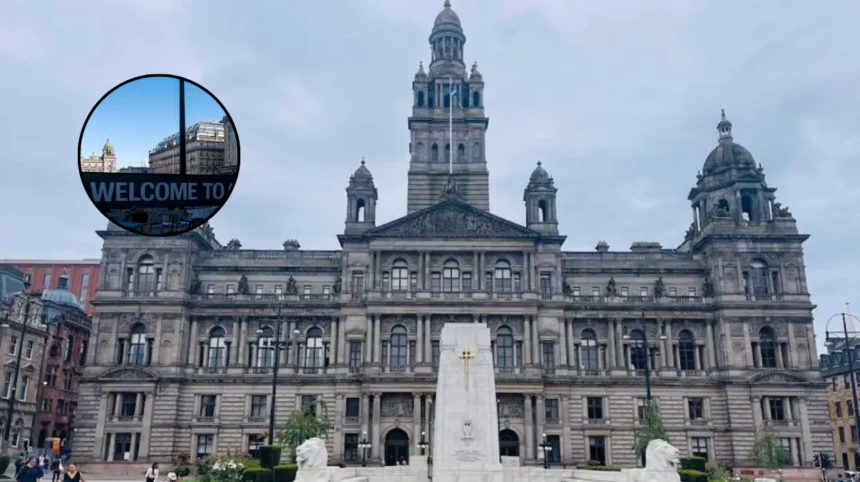
Laid out in 1781 and named after King George III, George Square has functioned as Glasgow’s primary civic and ceremonial heart for over two centuries. Surrounding buildings reflect Victorian architecture, including the Glasgow City Chambers—designed by William Young and completed in 1889—and Queen Street Station, which opened in 1842.
Management of the square was formally assumed by the Glasgow Corporation in 1862. Over the decades, the site underwent periodic modifications, including the removal of perimeter iron railings in 1878, previous remodelling ahead of the 2014 Commonwealth Games, and subsequent public domain upgrades.
As reported by Zara Dosanjh of Time Out UK, the current £20 million makeover represents Glasgow’s most substantial public realm redesign since the pedestrianisation of Buchanan Street in the 1970s.
The project forms a central pillar of Glasgow City Council’s broader Avenues Programme, funded via the Glasgow City Region City Deal.
The primary objectives of the redesign are to modernize civic infrastructure, enhance urban greening, and prioritize pedestrian accessibility over vehicular traffic. Specific design features scheduled for installation include:
- High-quality granite stone surfacing across all pedestrian pathways.
- Enhanced green landscaping, including rain gardens and new tree species to supplement existing Cherry and Norway Maple trees.
- Informal play zones and sensory gardens situated in the eastern precinct.
- A raised lawn platform, bespoke sheltered seating options, and upgraded feature lighting systems.
- Integrated water features and improved event hosting infrastructure.
Site preparation commenced in January 2025 following the removal of winter holiday decorations. Security hoardings with public viewing portals were erected around the square, closing off public access while heavy engineering works began in April 2025.
How Will The Reopening Delay Affect Businesses, Commuters, And The Local Community?
The two-month extension to the full reopening date directly affects city-centre retailers, hospitality venues, and small business operators situated around George Square, St Vincent Place, Cochrane Street, and George Street.
The ongoing presence of security hoardings during the late summer trading window limits footfall movement across the central city core.
However, the partial opening of the western side in early September is expected to provide partial economic relief.
By restoring pedestrian thoroughfares connecting Queen Street Station to Buchanan Street, hospitality businesses on the western perimeter will experience increased pedestrian traffic ahead of the full autumn opening.
For commuters utilizing Queen Street Station and regional bus routes, the ongoing construction requires continued adaptation to temporary pedestrian diversions. The successful reopening of the north carriageway in June 2026 has already relieved initial vehicular traffic congestion around Hanover Street and George Street.
Pedestrians will gain improved access as perimeters open incrementally. The planned September event will offer the public its first direct interaction with the new granite pathways, widened footways, and traffic-free zones prior to the total removal of eastern site hoardings in October 2026.
Explore More Glasgow Council News
Glasgow Council Faces Backlash Over Parent Legal Bill: Glasgow 2026
Free Period Products for Commonwealth Games Visitors Glasgow 2026
What Are The Long-Term Expectations For Glasgow’s Civic Space?
Once the final hoardings are removed at the end of October 2026, Glasgow will gain a modernized, fully accessible public realm space designed to accommodate major cultural events, civic gatherings, and daily recreation.
City leaders anticipate that while short-term subterranean delays have lengthened the timeline, the completed project will deliver long-term environmental, aesthetic, and economic benefits for residents and tourists alike.