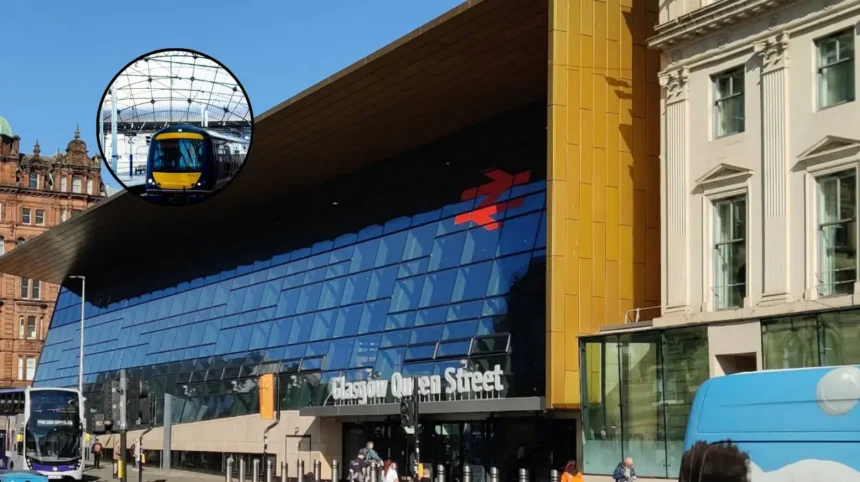
Key Points
- ScotRail has confirmed replacement buses are in place after some services between Glasgow and Edinburgh Waverley were cancelled.
- The disruption is being caused by an overhanging tree branch between Blairhill and Coatbridge Sunnyside.
- ScotRail said the line is currently closed while Network Rail works to resolve the problem.
- The disruption has affected services on a busy rail corridor used by passengers travelling between Glasgow Queen Street and Edinburgh Waverley.
- National Rail later recorded disruption on a separate Coatbridge Sunnyside incident that was cleared the same day, though that alert referred to a fire next to the track rather than the tree branch issue.
Glasgow (Glasgow Express) July 04, 2026 – ScotRail has confirmed that some trains between Glasgow and Edinburgh Waverley have been cancelled because of an overhanging tree branch between Blairhill and Coatbridge Sunnyside, with replacement buses now running while engineers deal with the fault.
What did ScotRail say about the line closure?
As reported by BBC News, ScotRail said:
“Due to an overhanging tree branch between Blairhill and Coatbridge Sunnyside, the line is currently closed.”
The operator added that Network Rail was making efforts to resolve the problem. That means the disruption is being treated as an infrastructure issue rather than a timetable-only adjustment.
The cancellation of some services has created knock-on effects for passengers travelling on the Glasgow Queen Street to Edinburgh Waverley route.
ScotRail’s confirmation that replacement buses are in effect indicates rail journeys on the affected section cannot currently run as planned.
Which services are affected?
The BBC report states that travellers at Glasgow Queen Street are being hindered by the branch between Blairhill and Coatbridge Sunnyside.
The affected route is important because it connects two of Scotland’s major rail hubs and is used by commuters, day-trippers and longer-distance passengers.
National Rail’s separate incident page for Coatbridge Sunnyside shows how quickly disruption can alter services on this corridor, with route changes affecting travel between Airdrie and Balloch as well as Edinburgh and Helensburgh Central during a later event.
Although that specific update was for a fire next to the track, it underlines how sensitive this stretch of the network can be to local incidents.
Why do tree-related incidents cause major disruption?
Overhanging branches or fallen trees can force rail operators to close lines because they pose a direct safety risk to trains and passengers.
Even when the obstruction is limited to one area, services may be stopped across a wider section of the route while inspections and clearance work take place.
In this case, ScotRail’s decision to arrange replacement buses suggests services could not safely continue through the affected section until Network Rail completed work. That often leads to delays, cancellations and re-planning for passengers using the line.
What should passengers do now?
Passengers on the affected route should check live service updates before travelling, because replacement bus arrangements can change as work progresses.
The BBC report and ScotRail’s statement both show that the disruption is being handled in real time, so journey plans may need to be adjusted at short notice.
Travel patterns on the Glasgow Queen Street to Edinburgh Waverley corridor can be heavily affected when even a single obstruction closes the line.
For passengers, that usually means allowing extra time and being prepared for road replacement transport rather than a direct train journey.
Background of the development
The Glasgow Queen Street to Edinburgh Waverley corridor is one of the most heavily used rail links in central Scotland, so even local disruption can have a wider impact on commuting and connecting services.
Tree-related incidents on Scottish rail routes have previously caused cancellations and delays, including a separate BBC-reported case where a ScotRail train was punctured by a fallen tree near Arrochar and Ardlui.
Rail operators routinely rely on Network Rail to inspect and clear affected sections before trains can resume. National Rail’s later Coatbridge Sunnyside update also shows that the wider area has seen more than one interruption affecting ScotRail passengers.
Explore More Local Cardiff News
Glasgow Businessman Forfeits £106,801 in Fraud Case, Glasgow 2026
Benchmarx Kitchens Expands Trade Service with New Showroom Launch Glasgow 2026
Prediction
For regular commuters, this kind of disruption is likely to mean delays, missed connections and a stronger reliance on replacement buses until the line fully reopens.
For leisure travellers and anyone heading between Glasgow and Edinburgh, the main effect will be longer journey times and less predictable arrivals if similar weather- or tree-related incidents happen again.
For ScotRail and Network Rail, the immediate priority is restoring normal services quickly and safely, because repeated disruption on this route can affect passenger confidence.
If the branch is cleared promptly and no further damage is found, services should return closer to normal; if not, the cancellations could continue for longer than expected.