The North Atlantic cold blob is a persistent cool patch in surface waters southeast of Greenland that signals a slowdown in the Atlantic Meridional Overturning Circulation (AMOC) and influences weather patterns across the North Atlantic region, including the UK and Glasgow.
- What is the North Atlantic cold blob pattern?
- How does the cold blob affect the Atlantic Meridional Overturning Circulation?
- Why does freshwater from Greenland create a cold blob?
- How long has the North Atlantic cold blob been observed?
- What are the main physical mechanisms behind the cold blob?
- How does the cold blob influence weather in the UK and Europe?
- Does the cold blob make Glasgow colder or warmer?
- How does the cold blob interact with Atlantic depressions that affect Glasgow?
- What do climate scientists say about the cold blob and AMOC slowdown?
- How might the cold blob affect sea level and storm risk for the UK?
- What is the future outlook for the North Atlantic cold blob?
- How does the cold blob fit into Glasgow’s broader climate change context?
- What can Glasgow residents and planners take from the cold blob science?
What is the North Atlantic cold blob pattern?
The North Atlantic cold blob is a large, persistent area of unusually cool sea surface temperatures southeast of Greenland, formed by reduced sinking of cold salty water and increased freshwater from Greenland melt, which weakens the AMOC and alters regional climate patterns.
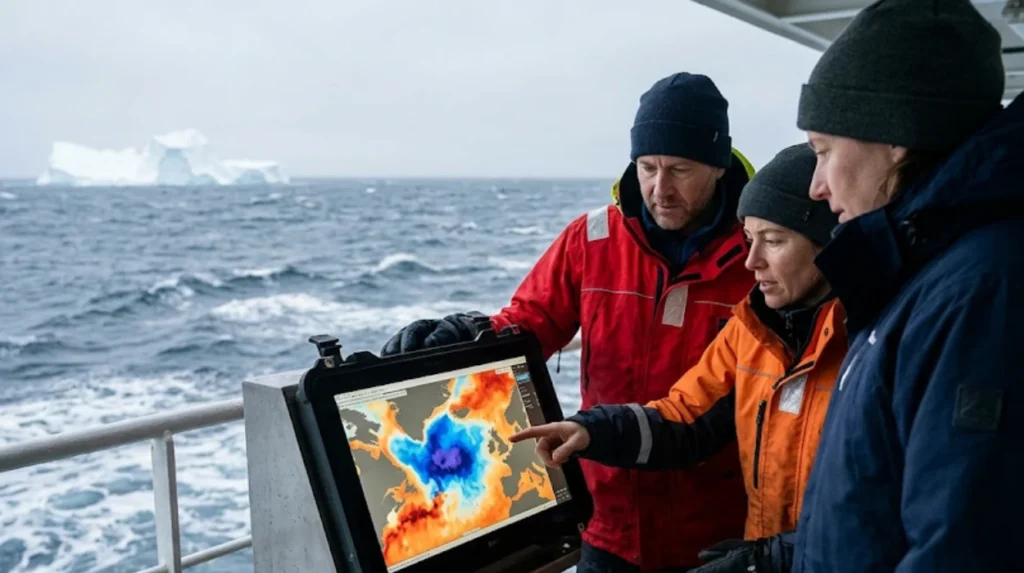
The cold blob, also called the North Atlantic warming hole, is the largest structurally anomalous cold oceanic region on Earth. It appears as a distinct blue “hole” in global temperature maps during warm years such as 2015, when the rest of the world was unusually hot. The anomaly is centred roughly between 40°N–65°N and 60°W–20°W, downstream of Greenland and upstream of the British Isles.
This pattern is not a short-term dip in temperature but a multi-decadal feature that has strengthened since at least the 1970s and is linked to changes in ocean circulation rather than just local weather swings. It reflects how the deep ocean is responding to global warming, especially through the melting of the Greenland ice sheet and increased freshwater input into the northern Atlantic.
How does the cold blob affect the Atlantic Meridional Overturning Circulation?
The cold blob marks a region where the AMOC is slowing: less cold, salty water sinks, so the deep southward flow weakens, reducing the northward heat transport that normally keeps northwestern Europe warmer than its latitude would suggest.
The AMOC is the large-scale ocean circulation that moves warm surface water northward, where it cools, becomes salty and dense, then sinks to form deep water that flows southward. This process is driven by temperature and salinity differences, known as thermohaline forcing. When Greenland melts and adds freshwater, surface waters become less salty and less dense, so they do not sink as readily.
The cold blob is a surface expression of this reduced sinking. As the collapse of deep water formation slows, heat stays trapped deeper or is redistributed differently, leaving a cold surface anomaly in the subpolar North Atlantic. Studies using satellite and ocean data show that the AMOC has experienced an exceptional slowdown in the last century, with the cold blob intensifying as a visible signal.
Why does freshwater from Greenland create a cold blob?
Melting Greenland ice adds freshwater that lowers salinity, making surface water less dense and preventing it from sinking, which reduces the AMOC and leaves a cold patch where heat is no longer drawn downward efficiently.
Freshwater from Greenland enters the ocean as meltwater and runoff, diluting the salt content of surface waters in the subpolar North Atlantic. Saltier water is denser and sinks when it cools; fresher water stays near the surface. This change in density weakens the “conveyor belt” that pulls warm water north and returns cold water south.
Satellite studies using GRACE data show that freshwater runoff from Greenland has been accelerating, which can eventually disrupt the AMOC if it continues over long periods. This mechanism ties the cold blob directly to global warming: more heat → more melt → more freshwater → weaker AMOC → colder surface anomaly in the subpolar North Atlantic.
How long has the North Atlantic cold blob been observed?
The cold blob has been detectable since at least the 1970s, with evidence of a substantial change in AMOC unfolding since then, and it has become more prominent in recent decades as Greenland melt has accelerated.
Scientific observations note that the anomaly was already present in the 1970s, and some studies suggest this slowdown may have been unprecedented over the last millennium. The RAPID monitoring program, established in 2004, has provided continuous data on ocean circulation and helped track the evolution of the cold blob over time.
By 2015, the cold blob appeared clearly in NASA–NOAA global temperature maps, even though 2015 was the warmest year in the NASA temperature series at that time. This contrast highlights that the cold blob is a regional anomaly opposite to the global trend of warming.
What are the main physical mechanisms behind the cold blob?
The cold blob arises from a combination of reduced deep water formation, increased freshwater from Greenland, changes in wind-driven circulation linked to the North Atlantic Oscillation and Atlantic Multidecadal Oscillation, and altered heat exchange between ocean and atmosphere.
The primary mechanism is the freshwater effect on salinity and density, which limits sinking of cold surface water and reduces the northward heat flux carried by the AMOC. Secondary mechanisms include natural variability: wind patterns influenced by the North Atlantic Oscillation (NAO) and the Atlantic Multidecadal Oscillation (AMO) can change ocean temperatures and circulation without any meltwater input.
These wind-driven effects can amplify or oppose the freshwater-driven slowdown, meaning the cold blob is not purely a one-cause phenomenon but a result of multiple interacting processes in the ocean and climate system.
How does the cold blob influence weather in the UK and Europe?
A weaker AMOC associated with the cold blob tends to bring cooler winters and summers around the North Atlantic, with possible shifts in storm tracks and regional climate patterns that can affect the UK’s frequency of Atlantic depressions and strong winds.
Don Chambers from the USF College of Marine Science noted that the major effect of a slowing AMOC is expected to be cooler winters and summers around the North Atlantic, along with small regional increases in sea level on the North American coast. This means that while the rest of the world warms, parts of northwestern Europe, including the UK, may experience relative cooling or slower warming in some seasons.
The cold blob can also alter where and how often Atlantic storms develop and move. Changes in the temperature gradient between the cold subpolar region and warmer tropical waters can influence the path and intensity of low-pressure systems that regularly reach the UK. This has implications for wind, rain, and storm frequency, which are key features of Glasgow’s weather.
Does the cold blob make Glasgow colder or warmer?
The cold blob does not make Glasgow uniformly colder; it can moderate summer warming and alter storm behaviour, while Glasgow’s overall climate continues to warm due to global climate change, with hotter summers and more intense rainfall events expected.
Glasgow already has a temperate maritime climate shaped by Atlantic depressions that bring rain and wind throughout the year, especially in autumn and winter. The cold blob may slightly reduce the rate of summer warming or increase variability in wind and storm patterns, but it does not override the long-term warming trend driven by greenhouse gases.
Met Office projections for Glasgow under high emissions pathways indicate that summer maximum temperatures could rise by 2.6–6.9°C by 2070, and hot spells could increase from once every 4 years to about 4 times per year. At the same time, winter precipitation is expected to increase by 10–23%, and the risk of heavy rainfall events in summer may rise even if average summer rainfall falls.
How does the cold blob interact with Atlantic depressions that affect Glasgow?
Atlantic depressions are low-pressure systems that develop over the Atlantic and move northeast, bringing Glasgow its characteristic wind and rain; the cold blob can modify the temperature gradient that drives these systems and potentially shift their tracks or intensity.
Glasgow receives much of its rainfall from Atlantic depressions that affect Scotland year round, with higher frequency in autumn and winter. These systems rely on contrasts between warm tropical air and cold polar air; changes in the North Atlantic temperature pattern, such as the cold blob, can alter where these contrasts are strongest.
A stronger cold blob may strengthen the temperature gradient in some parts of the subpolar Atlantic, potentially affecting storm tracks and the frequency of strong winds from the southwest, which are the strongest winds experienced in Glasgow. This interaction is complex and still being studied, but it is plausible that the cold blob influences the behaviour of the very systems that define Glasgow’s weather.
What do climate scientists say about the cold blob and AMOC slowdown?
Leading climate scientists, including Michael Mann and Stefan Rahmstorf, argue that the cold blob is a visible sign of an exceptional AMOC slowdown in the last century, likely contributed by Greenland melt, while others such as Tom Delworth point to natural variability from the NAO and AMO as additional factors.
Mann and Rahmstorf published findings concluding that the AMOC shows an exceptional slowdown in the last century, with Greenland melt as a possible contributor, and that the cold pattern during record-hot years is a sign of this weakening. Jon Robson and colleagues from the University of Reading concluded in 2014 that “a substantial change in the AMOC is unfolding now”.
Tom Delworth of NOAA has highlighted that natural variability, including wind-driven ocean temperature changes linked to the North Atlantic Oscillation and Atlantic Multidecadal Oscillation, also plays a role, meaning the cold blob is not solely a greenhouse-warming signal. Didier Swingedouw suggested that the slowdown in the 1970s may have been unprecedented over the last millennium, underscoring the significance of the phenomenon.
How might the cold blob affect sea level and storm risk for the UK?
A slowing AMOC linked to the cold blob is expected to produce small regional sea level increases on the North American coast and may influence storm behaviour, with potential implications for wind and rainfall patterns that affect the UK, including Glasgow.
Research on the U.S. East Coast shows that a reduced AMOC can lead to 3–4 times higher than global average sea level rise rates in that region, due to changes in deep water formation and ocean circulation. For Europe and the UK, the sea level signal is smaller but still relevant, especially when combined with global sea level rise from warming oceans and melting ice.
Changes in AMOC and the cold blob can alter where and how often strong Atlantic storms develop, which affects the frequency of high winds and heavy rain in the UK. Glasgow already experiences frequent strong winds from the southwest and significant rainfall from Atlantic depressions; any shift in storm tracks or intensity driven by the cold blob could influence future risk patterns for wind damage and flooding.
What is the future outlook for the North Atlantic cold blob?
If Greenland melt continues to accelerate and greenhouse gas emissions remain high, the cold blob is likely to persist and possibly strengthen, reinforcing AMOC slowdown and continuing to influence North Atlantic climate patterns for decades.
Studies using GRACE satellite data indicate that freshwater runoff from Greenland is accelerating, which could eventually cause a disruption of the AMOC in the future, affecting Europe and North America. Higher carbon emission rates are linked to increased sea level rise in regions influenced by AMOC changes, pointing to a broader system response to climate change.
The long-term evolution of the cold blob depends on how quickly the Greenland ice sheet melts, how much freshwater enters the ocean, and how natural variability interacts with these changes. Even if emissions are reduced, the inertia of the ocean system means that the cold blob and its impacts could persist for many decades.
How does the cold blob fit into Glasgow’s broader climate change context?
In Glasgow, the cold blob is one regional factor within a larger warming trend: the city is already experiencing warmer temperatures, more intense rainfall events, and shifting seasonal patterns, with projections of hotter summers and wetter winters under high emissions scenarios.
Met Office data for Glasgow show that annual mean air temperature has been rising since 1884, with summer and winter temperature increases projected to continue under all emission pathways. Hot summers are expected to become more common, with a 50% chance by 2050 of summers as hot as 2018, one of the warmest UK summers to date.
Glasgow’s rainfall patterns are also changing: while summers may become drier on average, the intensity of heavy summer rainfall events could increase, and winter precipitation is projected to rise by 10–23% under high emissions. The cold blob may modulate some of these trends, especially in terms of storm behaviour and wind patterns, but it does not reverse the overall warming and wetting of winters that Glasgow faces.

What can Glasgow residents and planners take from the cold blob science?
Glasgow residents and planners should treat the cold blob as evidence that North Atlantic climate is becoming more complex: they must prepare for hotter summers, more intense rainfall, and potentially shifting wind and storm patterns, while recognising that local weather will still be dominated by Atlantic depressions and maritime influences.
Practical steps include maintaining robust drainage and flood management to handle heavier rainfall events, planning for more frequent hot spells and heat stress in summer, and keeping infrastructure resilient to strong southwest winds that remain Glasgow’s most hazardous wind direction. Understanding the cold blob helps explain why some aspects of regional climate may not follow the global warming trend in a simple way, but it does not reduce the need for adaptation to the broader climate changes projected for Glasgow.
The cold blob is a long-term, research-backed feature of the North Atlantic climate system that interacts with global warming, Greenland melt, and natural variability. For Glasgow, it adds nuance to expectations about temperature, storms, and wind, but the city’s future climate remains firmly shaped by accelerating warming, more intense rainfall, and a maritime climate that continues to bring Atlantic depressions year round.
What is the North Atlantic cold blob?
The North Atlantic cold blob is a persistent area of unusually cool sea surface temperatures southeast of Greenland. Scientists consider it one of the strongest regional ocean temperature anomalies on Earth and an important indicator of changes in the Atlantic Ocean circulation.