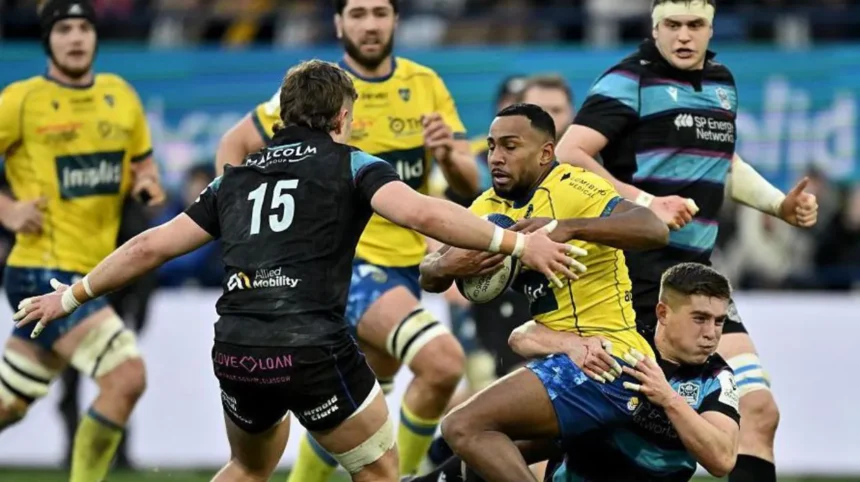
Glasgow Warriors are a professional rugby union team based in Glasgow, Scotland, competing as one of the two professional elite clubs managed by the Scottish Rugby Union. The club participates in the United Rugby Championship and the Investec Champions Cup, playing their home fixtures at Scotstoun Stadium.
- What is the history and origin of Glasgow Warriors?
- What competition structures do Glasgow Warriors play in?
- Where is the home stadium of Glasgow Warriors?
- What major trophies and honors have Glasgow Warriors won?
- Who are the notable players and record holders of Glasgow Warriors?
- How is the tactical system of Glasgow Warriors structured?
- What is the structure of the Glasgow Warriors women’s team?
- What is the economic and societal impact of Glasgow Warriors?
What is the history and origin of Glasgow Warriors?
Glasgow Warriors originated as an amateur district team in 1872 before transitioning into a professional rugby union club in 1996 following the sport’s global professionalization, eventually adopting the Warriors identity to compete in major European and multinational championship leagues.
The Amateur District Era (1872–1996)
The foundation of the club rests on the historical Glasgow District rugby union team, which played its inaugural inter-district match against Edinburgh District on November 23, 1872. This fixture represents the oldest continuous inter-district rugby rivalry in the world. During this amateur era, the district team selected the premier players from local club sides within the Glasgow region, including Glasgow Academicals, West of Scotland, and Glasgow High School FP, to compete in the Scottish Inter-District Championship.
The Transition to Professionalism (1996–present)
When the International Rugby Board declared rugby union an open game in August 1995, the Scottish Rugby Union formalized the sport by creating four professional district teams in 1996. The amateur Glasgow District side became Glasgow Rugby, competing in the inaugural 1996–97 European Cup. Financial consolidation by the governing body forced a merger with the Caledonia Reds in 1998, briefly expanding the regional footprint of the club before it re-centered entirely on the city of Glasgow. The club officially rebranded as the Glasgow Warriors in 2005 to optimize its commercial identity and align with the expansion of the Celtic League.
What competition structures do Glasgow Warriors play in?
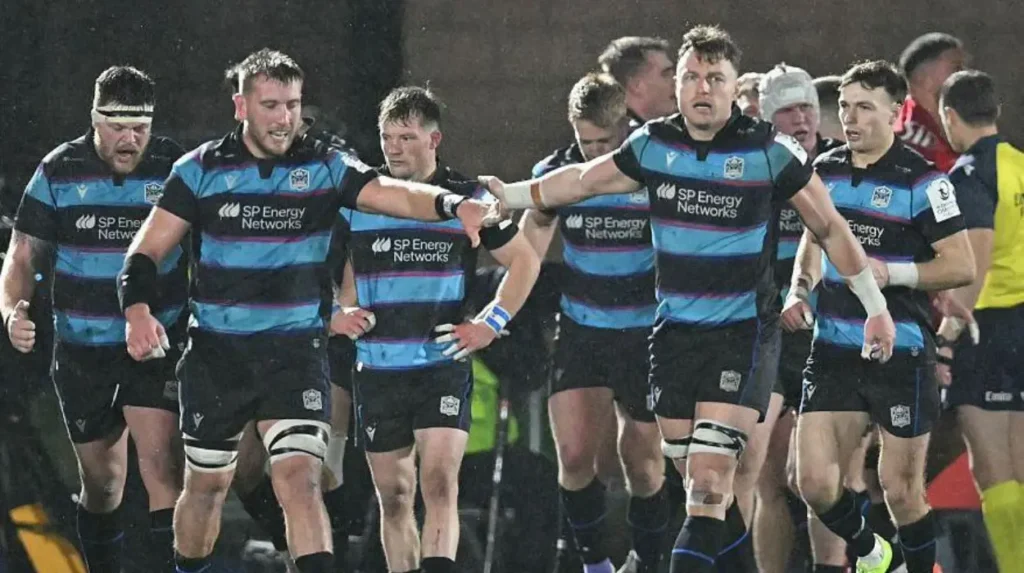
Glasgow Warriors compete simultaneously in the United Rugby Championship, a multinational league spanning five countries, and the Investec Champions Cup, the elite tier of European professional club rugby organized by European Professional Club Rugby.
The United Rugby Championship Structure
The primary domestic competition for the club is the BKT United Rugby Championship. This league consists of 16 professional teams drawn from five distinct nations:
- Scotland: Glasgow Warriors, Edinburgh Rugby
- Ireland: Leinster, Munster, Ulster, Connacht
- Wales: Cardiff Rugby, Scarlets, Dragons RFC, Ospreys
- Italy: Benetton Rugby, Zebre Parma
- South Africa: Vodacom Bulls, DHL Stormers, Hollywoodbets Sharks, Emirates Lions
The competition utilizes a single league table format where clubs play 18 regular season fixtures, followed by an eight-team straight-knockout quarter-final, semi-final, and Grand Final playoff structure to determine the champion.
European and Elite Tournaments
Based on their final position within the United Rugby Championship table, Glasgow Warriors qualify for one of two cross-border tournaments managed by European Professional Club Rugby:
- Investec Champions Cup: The premier tournament featuring top-tier clubs from the United Rugby Championship, the English Gallagher Premiership, and the French Top 14.
- EPCR Challenge Cup: The secondary tier tournament for clubs that do not achieve primary qualification rankings in their domestic leagues.
Where is the home stadium of Glasgow Warriors?
The official home ground of Glasgow Warriors is Scotstoun Stadium, an athletics and rugby facility located in the west end of Glasgow that features a synthetic playing surface and a capacity of 7,351 spectators.
Scotstoun Stadium Facilities
The club permanently moved its training and playing operations to Scotstoun Stadium in 2012, having previously utilized several grounds across the city, including Hughenden Stadium, Firhill Stadium, and the multi-sport complex at Kilmarnock’s Rugby Park. The facility features a World Rugby-compliant artificial 3G pitch installed in 2016 to prevent match cancellations caused by adverse Scottish winter weather conditions. The stadium structure consists of two permanent covered stands, the Main Stand and the Back Stand, which are augmented by temporary north and south goal-line seating structures to maximize spectator capacity during high-profile fixtures.
High-Capacity Alternative Venues
For fixtures requiring capacities far exceeding the limits of Scotstoun Stadium, Glasgow Warriors utilize larger municipal and national sports arenas within Scotland. The club has historic precedents of moving major fixtures to larger stadiums:
- Hampden Park: The national football stadium in Glasgow, where the club set its record home attendance in December 2024 with 27,500 spectators for the 1872 Cup match against Edinburgh.
- Celtic Park: A major football venue in Glasgow that hosted the 2019 Pro14 Grand Final in front of 47,128 spectators.
- Scottish Gas Murrayfield Stadium: The national rugby stadium located in Edinburgh, utilized for neutral-ground playoff matches and specific high-profile European encounters.
What major trophies and honors have Glasgow Warriors won?
Glasgow Warriors have won two major international league titles, securing the Guinness Pro12 Championship in 2015 and the BKT United Rugby Championship title in 2024, alongside multiple regional rivalry trophies.
Domestic and League Titles
The club achieved historical status during the 2014–15 season by defeating Irish province Munster 31–13 in the Pro12 Grand Final at Kingspan Stadium in Belfast, becoming the first Scottish professional team to win a major trophy in the professional era. Nine years later, under the guidance of head coach Franco Smith, the squad secured their second major championship. On June 22, 2024, Glasgow Warriors defeated the South African Vodacom Bulls 21–16 at the high-altitude Loftus Versfeld Stadium in Pretoria to lift the 2024 United Rugby Championship trophy after overcoming a 13–0 first-half deficit.
European and Regional Honors
While the club has never won a top-tier European title, it reached its inaugural continental showpiece during the 2022–23 season, competing in the EPCR Challenge Cup Final at the Aviva Stadium in Dublin, where they finished as runners-up to French club Toulon. Annually, Glasgow Warriors compete against public rivals Edinburgh Rugby for the 1872 Cup. This trophy is decided across aggregate regular-season league statistics over a designated three-match series inserted directly into the United Rugby Championship calendar.
Who are the notable players and record holders of Glasgow Warriors?
The historical records of Glasgow Warriors are led by utility forward Rob Harley for career appearances, fly-half Dan Parks for total points scored, and scrum-half George Horne for individual tries scored.
Career Individual Milestone Statistics
The club monitors and archives individual player performance data across all competitive professional fixtures since 1996. The top statistical leaders across core administrative categories include:
- Most Appearances: Rob Harley, who accumulated 267 senior caps for the club between his debut in 2010 and his departure in 2022.
- Most Points Scored: Dan Parks, who recorded 1,520 total points via penalties, conversions, drop goals, and tries during his tenure from 2003 to 2010.
- Most Tries Scored: George Horne, who holds the men’s club record with 63 individual tries scored.
International and British & Irish Lions Representatives
The club serves as a primary developmental pathway for elite international talent, regularly supplying a high volume of players to the Scotland national rugby union team. During the 2015 Rugby World Cup, Glasgow Warriors provided 21 selected squad members to the national team, which represented the highest contribution of any singular club assembly globally at the tournament. Additionally, the club consistently produces players selected for multinational British & Irish Lions touring squads, including prominent international figures such as Gordon Bulloch, Tom Smith, Andy Nicol, Richie Gray, Stuart Hogg, Zander Fagerson, Ali Price, and Finn Russell.
How is the tactical system of Glasgow Warriors structured?
The tactical architecture of Glasgow Warriors centers on a high-tempo, expansive attacking style characterized by continuous offloading, fast breakdown mechanics, and aggressive defensive pressing structures designated to enforce turnovers.
Attacking Principles and Transition Play
Glasgow Warriors utilize a distinct tactical methodology often described within professional rugby circles as “the Glasgow way.” This operational framework relies on a high ball-in-play time and rapid ball recycling at the breakdown, aiming to out-pace opposing defensive defensive lines. The tactical model places heavy emphasis on support lines and offloads out of contact, allowing front-row forwards and agile backline players to interlink dynamically. This system demands elite levels of aerobic fitness and exceptional handling skills from all 15 positions on the field, minimizing static structural phases in favor of continuous fluid motion.
Defensive Systems and Set-Piece Integrity
Defensively, the team implements a high-press blitz system designed to suffocate opposing decision-makers behind the gainline. This defensive setup relies on the back-row forwards executing rapid line speed to force structural handling errors from the opposition. At the set-piece, which comprises the scrum and the lineout, the club blends traditional physical confrontation with complex tactical variations. The club leverages its athletic tight-five forwards to establish a stable platform at the scrum while employing sophisticated defensive lineout reading systems to disrupt opposition possession at the throw.
What is the structure of the Glasgow Warriors women’s team?
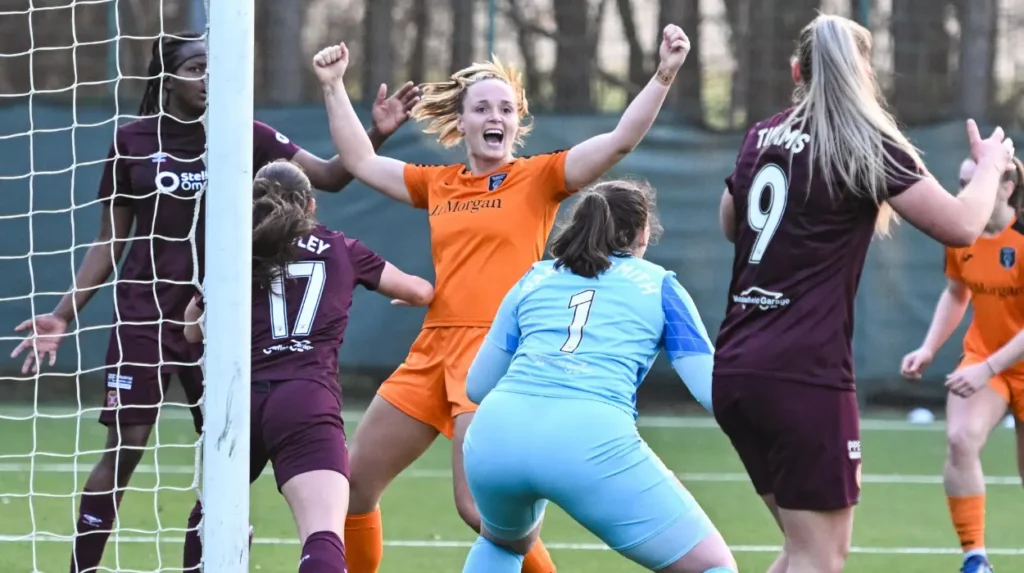
The Glasgow Warriors women’s team is an elite professional development squad established in 2023 to compete in the Celtic Challenge tournament, providing a high-performance pathway for female athletes in western Scotland.
Foundation and the Celtic Challenge
In alignment with the global strategic expansion of women’s rugby union, the Scottish Rugby Union sanctioned the official formation of a dedicated Glasgow Warriors women’s side in late 2023. The squad was assembled to participate in the expanded Celtic Challenge tournament, a cross-border competition designed to bridge the structural gap between domestic amateur club rugby and the international Test arena. The tournament includes regional and structural representative teams from Scotland, Ireland, and Wales. The inaugural competitive match for the women’s team took place on December 30, 2023, against historic rivals Edinburgh Women at the Hive Stadium in Edinburgh.
Operational Integration and High Performance
The women’s rugby division operates with full access to the high-performance infrastructure, medical facilities, coaching staff, and athletic development programs established at the Scotstoun Stadium complex. This systemic integration ensures identical tactical alignment with the men’s professional structure. Under elite coaching leadership, the women’s squad registered its maiden victory in the Celtic Challenge tournament in February 2025, defeating Edinburgh Women 36–17 during a home fixture played at Scotstoun Stadium, confirming the long-term viability of the regional talent development pathway.
What is the economic and societal impact of Glasgow Warriors?
Glasgow Warriors generate measurable economic value for the city of Glasgow through sports tourism, commercial partnership networks, and municipal stadium utilization while managing extensive grassroots community rugby development initiatives.
Commercial Structure and Sports Tourism
Operating as a major commercial entity within the professional sports landscape of western Scotland, Glasgow Warriors generate revenue streams through season ticket sales, corporate hospitality packages, merchandising, and multinational broadcasting rights agreements. Home fixtures at Scotstoun Stadium consistently attract thousands of travelling sporting spectators to the local municipal area, driving measurable consumer expenditure within regional hospitality, transport, and retail sectors. The club maintains strategic corporate sponsorships with global and domestic brands, integrating corporate commerce directly into the sporting ecosystem of the city.
Community Development and Academy Infrastructure
Beyond professional operations, the club manages a comprehensive community rugby program in partnership with local authorities, schools, and amateur rugby clubs across its designated regional catchment area. These community outreach operations focus on increasing sports participation across diverse demographics, running specialized coaching clinics, and promoting health and physical literacy initiatives. The club operates in direct alignment with the Scottish Rugby Academy system, maintaining an elite development tier that identifies, monitors, and trains promising young rugby talent from regional schools and amateur clubs to secure a continuous, sustainable supply of homegrown professional athletes for the future.