Key points
- Glasgow City Council has unveiled City Development Plan 2 (CDP2), a ten‑year strategy to guide regeneration and growth in the city.
- The plan aims to make land available for more than 30,000 new homes, with sites proposed along the River Clyde corridor, in north and north‑east Glasgow, and on reused brownfield land.
- CDP2 includes proposals for 36 “areas of change” across the city, setting out where development should and should not occur.
- The council’s Economy, Housing, Transport and Regeneration Committee has approved the outline plan, which will next be reviewed by the City Administration Committee and then opened to public consultation.
- The blueprint also sets out economic development areas to support business growth and employment, focusing on sectors such as digital and tech, finance and business services, advanced manufacturing, space and satellite, life sciences, the creative economy, tourism, and higher and further education.
- The plan proposes town centre regeneration in Drumchapel, Easterhouse, Shawlands and Castlemilk, alongside fresh guidance for city centre expansion, including improved public transport and active travel links.
- A River Park along the Clyde and the reuse of underused buildings – especially in the city centre – are highlighted as part of the strategy to tackle the climate and biodiversity crises and child and family poverty.
Glasgow (Glasgow Express) 22, May 2026 – Glasgow City Council has set out a sweeping ten‑year blueprint that could see more than 30,000 new homes built across the city, alongside major economic and environmental initiatives. The City Development Plan 2 (CDP2), approved in principle by the council’s Economy, Housing, Transport and Regeneration Committee, is now awaiting formal adoption and a period of public consultation before it becomes the statutory framework for land‑use decisions.
- Key points
- Where will the 30,000 new homes be built?
- What does the plan mean for the city centre and town centres?
- How will the plan support jobs and economic growth?
- How will the plan address climate and social issues?
- What is the background of this development?
- What could this development mean for the people of Glasgow?
As reported by STV News, CDP2 forms part of a wider regeneration strategy intended both to ease the city’s housing crisis and to reinforce Glasgow as the
“heart of Scotland’s only metropolitan area”.
The plan identifies 36 “areas of change”, which are geographically defined zones where land‑use rules are altered to allow new housing, employment space and infrastructure.
As Project Scotland notes, these areas are concentrated along the River Clyde corridor, across north and north‑east Glasgow, and on brownfield sites that have remained underused or vacant.
The same report emphasises that the plan is not simply about housing numbers but also about creating “quality, accessible and welcoming” places, with infrastructure and public‑realm upgrades designed to support higher‑density living.
Where will the 30,000 new homes be built?
The plan’s housing target – over 30,000 new dwellings over the next decade – is tied to the 36 areas of change.
According to the council’s own outline, significant numbers of homes are expected along the Clyde corridor, where former industrial land and waterside sites are being repurposed for mixed‑use development.
As outlined by Glasgow Chamber of Commerce, new housing will also be concentrated in north and north‑east Glasgow, areas that have seen lower levels of recent investment but where existing infrastructure and transport links can support densification.
The plan specifically encourages the reuse of brownfield land, which the chamber notes can help limit outward sprawl and protect greenbelt and open‑space areas.
The River Park along the Clyde – a linear public space running alongside the river – is positioned as a key amenity for residents of these new communities, with the aim of improving access to nature, cycling routes and leisure facilities.
What does the plan mean for the city centre and town centres?
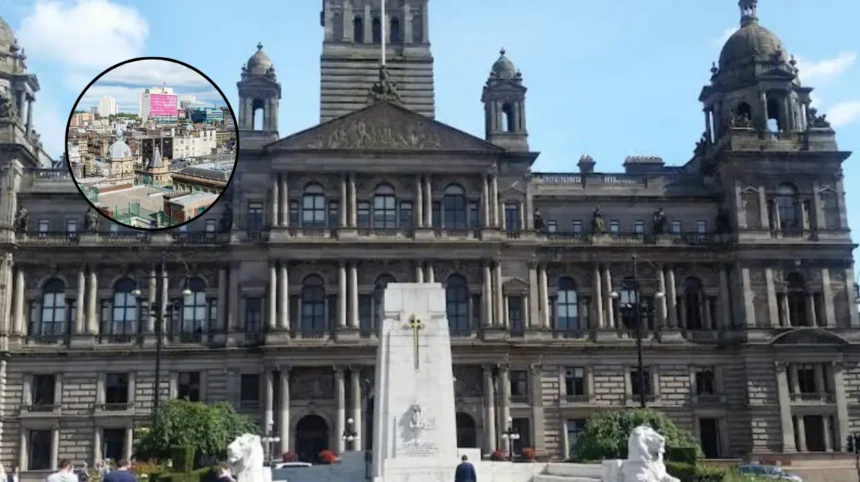
Alongside housing, the council is pushing a city‑centre regeneration strategy that ties into CDP2. The blueprint outlines priority areas for expansion in the city centre, including sites suited to offices, retail, hospitality and residential conversion of underused buildings.
As reported by STV News, the plan encourages the reuse of vacant and underused buildings, particularly in the city centre, to support a mix of uses and to reduce the need for large‑scale new construction on greenfield sites.
The council also flags public transport and active travel improvements as central to making higher‑density living viable, including better bus corridors, cycle lanes and pedestrian routes.
Smaller town centres are not being overlooked. The plan includes tailored regeneration proposals for Drumchapel, Easterhouse, Shawlands and Castlemilk, which the council hopes will strengthen local economies, improve shops and services, and make these areas more attractive places to live.
How will the plan support jobs and economic growth?
Beyond housing, CDP2 aims to act as a spatial framework for economic development. The council has identified several economic development areas (EDAs) where business growth, innovation and infrastructure investment will be concentrated.
As detailed by Glasgow Chamber of Commerce, priority sectors include digital and tech, finance and business services, advanced manufacturing and innovation, space and satellite, life sciences, the creative economy, tourism, and higher and further education.
The chamber notes that these areas are intended to attract both start‑ups and established firms, creating employment opportunities that match the city’s skills base and academic institutions.
The chamber also highlights that the plan is designed to make Glasgow more attractive to private investment, with clearer land‑use rules and long‑term certainty about where development can occur.
How will the plan address climate and social issues?
The council has positioned CDP2 as a tool to help tackle the climate emergency and biodiversity crisis, as well as entrenched social challenges such as child and family poverty.
As quoted by Project Scotland, Councillor Kelly, the convener of the Economy, Housing, Transport and Regeneration Committee, described the plan as
“the roadmap for Glasgow’s future, across the next decade and beyond,”
linking it explicitly to population growth, jobs, and climate‑led regeneration.
The plan’s emphasis on brownfield reuse, compact development, and active travel is framed as a way to reduce carbon emissions and car dependency.
The proposed River Park along the Clyde is also cited as a nature‑based solution that can improve air quality, provide green space and support biodiversity in heavily urbanised areas.
On the social side, the council and supporting bodies such as the Glasgow Chamber of Commerce argue that more homes, better‑connected town centres and stronger local economies can help ease pressures on families and reduce poverty over time.
What is the background of this development?
The City Development Plan 2 (CDP2) sits within a longer history of strategic planning in Glasgow. The city has previously used City Centre Strategies and local development frameworks to guide regeneration, most notably in the Broomielaw, Blythswood, Central and St Enoch districts of the city centre.
Earlier initiatives, such as the East End Local Development Strategy, have been held up as national examples of how to integrate social, economic and environmental objectives into a single spatial plan.
Those projects focused on creating a sustainable city district, improving microclimate, drainage and air quality, while also addressing local employment and community wellbeing.
CDP2 builds on that legacy by scaling similar principles across the entire city, using a 10‑year horizon and a long‑term land‑use framework rather than a series of smaller, disconnected schemes.
The plan is also being developed in parallel with broader integrated health and social care strategies and economic‑recovery programmes, creating what the council describes as a more joined‑up approach to Glasgow’s future.
What could this development mean for the people of Glasgow?
For home seekers and renters, the plan’s 30,000‑plus homes could, over time, help ease demand and rental‑market pressure, particularly if a significant share is delivered as affordable and social housing. However, the actual impact will depend on how quickly sites are unlocked, how much is designated for mid‑market versus social rent, and how the council balances density with quality of design and public space.
For existing residents in areas such as the Clyde corridor, north and north‑east Glasgow, Drumchapel, Easterhouse, Shawlands and Castlemilk, the plan may mean new housing estates, upgraded streets, and improved town‑centre facilities, alongside possible short‑term disruption from construction and traffic changes.
Transport‑network upgrades, if delivered as promised, could make these areas more accessible by public transport and by foot and cycle, which may benefit both older residents and families without cars.
For businesses and workers, the economic development areas and sector‑level ambitions could open up new employment zones, innovation hubs and commercial spaces, particularly in digital, tech, advanced manufacturing and life sciences. This could attract higher‑skill roles and inward investment, though the competitiveness of wages, skills training and local supply chains will determine how widely those benefits are spread.
From an environmental and health perspective, the combination of brownfield reuse, River Park development, and active‑travel improvements could, over the 10‑year period, lead to better air quality, more green space and healthier lifestyles in parts of the city that have historically had fewer such amenities.
At the same time, the success of these elements will hinge on consistent funding, enforcement of design standards and monitoring of biodiversity outcomes.