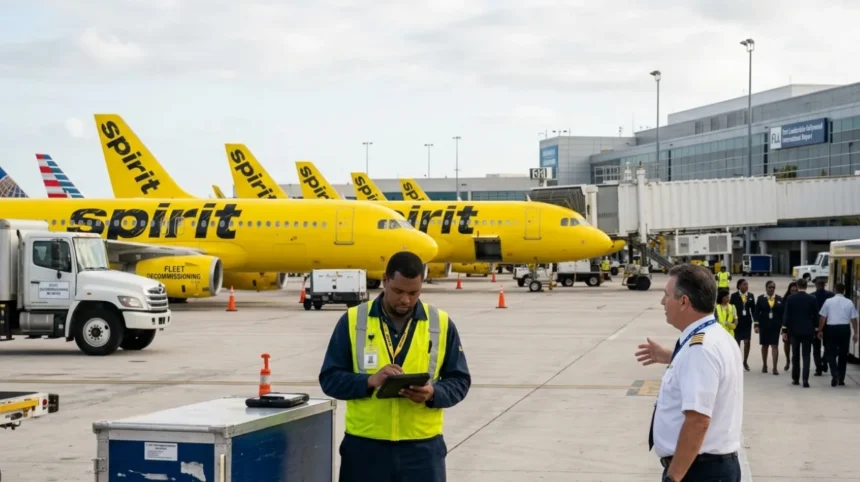
Spirit Airlines liquidation is the process in which the airline stops flying, ends operations, and sells assets to pay creditors after failing to stabilize its finances. Spirit announced an orderly wind-down and cancelled all flights on May 2, 2026, after rescue talks collapsed and liquidation risk became immediate.
- What does Spirit Airlines liquidation mean?
- Chapter 11 and liquidation
- Why did Spirit Airlines reach liquidation?
- Fuel costs and cash pressure
- How does airline liquidation work?
- What happens to passengers
- What changed after Spirit filed bankruptcy twice?
- Why the merger failure mattered
- What are the main impacts of liquidation?
- Impact on the airline market
- What does this mean for Glasgow readers?
- What should travelers and creditors do next?
- Why this case matters beyond Spirit
What does Spirit Airlines liquidation mean?
Spirit Airlines liquidation means the company stops operating as a going concern and moves into a process of selling assets, ending flights, and resolving creditor claims. In bankruptcy terms, liquidation differs from reorganization because the goal shifts from saving the airline to winding it down and paying creditors. In the United States, Chapter 11 usually supports reorganization, while Chapter 7 is the standard liquidation route.
Liquidation is a legal and financial endpoint. It follows a failure to restore cash flow, secure financing, or win enough creditor support for a viable restructuring plan. For airlines, liquidation also means route cancellations, aircraft returns, workforce reductions, refund disputes, and the loss of future ticket sales.
Spirit’s case matters because it shows how a company can move from restructuring to shutdown in a short period. Reuters reported in February 2026 that Spirit had reached a lender agreement intended to help it exit bankruptcy by late spring or early summer, but that plan later collapsed. By early May 2026, the airline had begun an orderly wind-down.
Chapter 11 and liquidation
Chapter 11 is the main U.S. bankruptcy framework for business reorganization. A company usually continues operating while it negotiates with creditors and proposes a repayment plan, and the court can approve borrowing and restructuring steps during the case.
Liquidation can still happen inside Chapter 11 if the company cannot support a workable reorganization. In that outcome, the business sells assets under court supervision rather than emerging as a revived airline. Spirit’s situation fits that pattern because the company first used Chapter 11 to survive, then moved toward wind-down when financing and rescue efforts failed.
Why did Spirit Airlines reach liquidation?
Spirit Airlines reached liquidation after years of losses, failed restructuring efforts, a second bankruptcy filing, and a sharp increase in fuel costs that weakened cash flow. The company also faced structural pressure from debt, weak demand recovery, aircraft engine issues, and the collapse of its JetBlue merger. Reuters reported that Spirit had filed for bankruptcy twice, first in November 2024 and then again in August 2025.
The airline’s problems were not isolated to one event. CNBC reported that Spirit faced a second bankruptcy within a year, a large fuel-price shock, and ongoing operational strain from grounded Airbus aircraft tied to Pratt & Whitney engine recalls. The blocked JetBlue merger also removed one possible path to scale and survival.
Spirit’s financial distress deepened after it emerged from its first bankruptcy. Reuters reported in February 2026 that the company had cut debt and negotiated with creditors, but later reports showed that those gains were not enough to withstand the next wave of pressure. BBC and Reuters both reported that rescue talks with the Trump administration failed, and the airline then announced an orderly wind-down.
Fuel costs and cash pressure
Fuel is one of the biggest costs in airline operations, second only to labor in many cases. CNBC reported that the 2026 fuel spike intensified Spirit’s distress and pushed liquidation into active consideration.
When fuel prices rise quickly, low-cost carriers face immediate pressure because their business model depends on thin margins and high aircraft utilization. Spirit’s model relied on budget fares, ancillary fees, and dense scheduling, so sudden cost inflation reduced the room for error.
Reuters reported that the company had been planning to shrink and focus on stronger routes in an effort to leave bankruptcy, but the fuel shock and broader pressure interrupted that plan. That shift is important because it shows how a restructuring plan can fail even after a lender agreement is signed.
How does airline liquidation work?
Airline liquidation works by freezing the old operating model, stopping flights, returning or selling aircraft and other assets, and using the proceeds to repay creditors under court oversight. The process also includes employee terminations, refunds, lease negotiations, and the handling of customer claims and frequent-flyer obligations. In a Chapter 7 liquidation, a trustee sells assets and distributes proceeds, while Chapter 11 can also end in a liquidating plan.
For airlines, liquidation is more complex than a normal business closure because aircraft are leased, not always owned, and airport access depends on slot rights, gates, maintenance contracts, and regulatory permissions. Those operational rights have value, so they become part of the asset unwind.
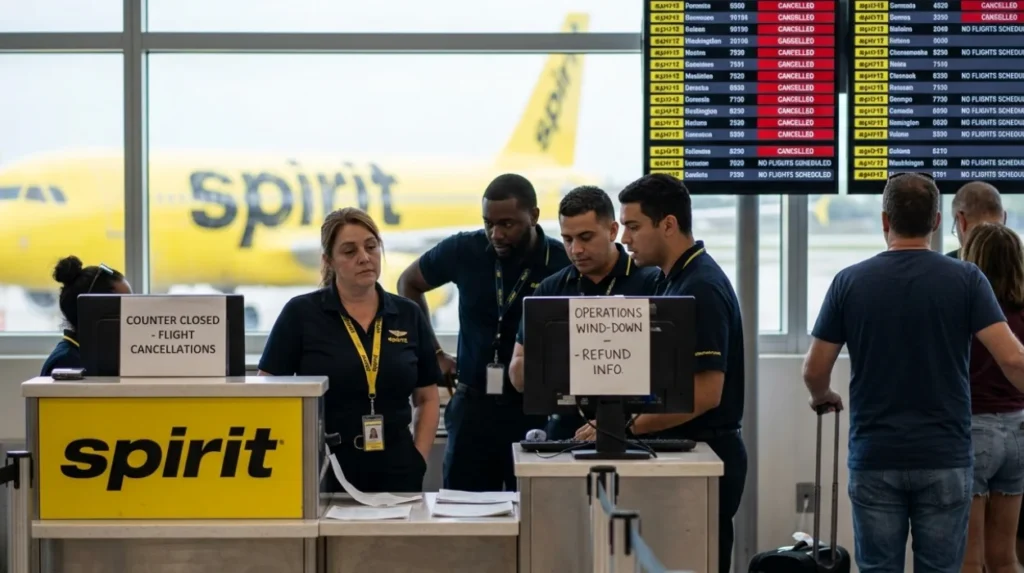
The process usually follows this sequence: the company announces the shutdown, cancels future flights, tells passengers not to travel to the airport, informs employees, and coordinates with regulators and lessors. Spirit’s May 2026 notice did exactly that, saying flights were cancelled and customer service was no longer available.
What happens to passengers
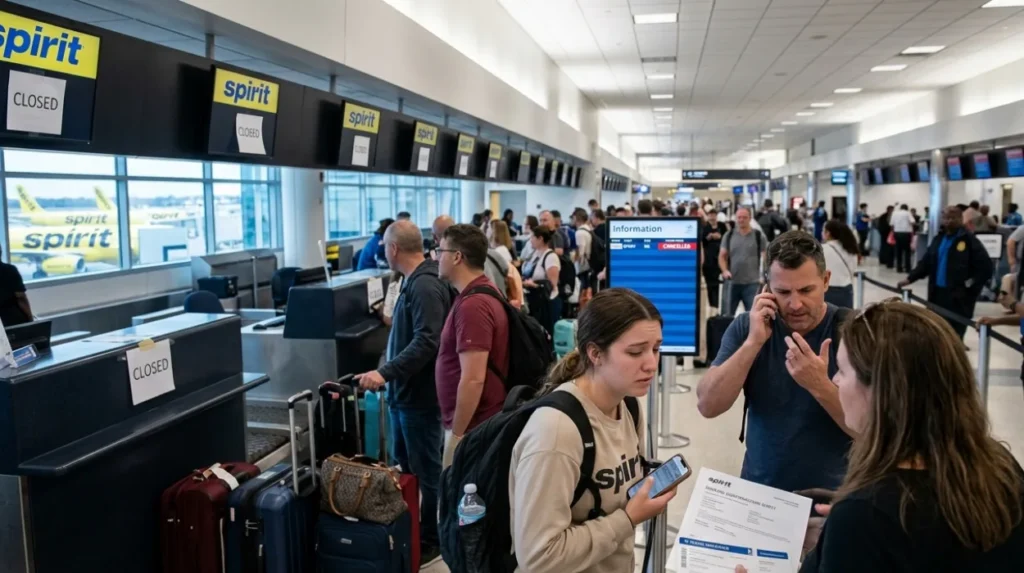
Passengers are usually affected first. When an airline stops operations, future tickets become unusable and customers must pursue refunds, chargebacks, or alternative travel arrangements through payment providers, travel insurers, or government consumer channels.
Spirit’s announcement said all flights were cancelled and customers should not travel to the airport. That means booked travelers face immediate disruption, especially on routes with no spare capacity from competing carriers.
For an airline like Spirit, which planned thousands of domestic flights over a short period, a shutdown affects a very large number of seat reservations at once. Al Jazeera reported that Spirit had planned 4,119 domestic flights between May 1 and May 15, offering 809,638 seats.
What changed after Spirit filed bankruptcy twice?
After Spirit filed bankruptcy twice, the company moved from recovery mode to survival mode. The first filing aimed to reorganize debt, but the second filing showed that the initial restructuring did not solve the airline’s core cost and demand problems. Reuters reported that Spirit emerged from its first Chapter 11 process in March 2025 and then entered another bankruptcy filing in August 2025.
That sequence matters because repeat bankruptcy usually signals that the first restructuring reduced debt but did not restore durable profitability. Spirit still faced weak margins, major operating costs, and a market that punished ultra-low-cost carriers more harshly after the pandemic rebound.
In February 2026, Reuters said Spirit had an agreement with lenders that supported an exit by late spring or early summer. By April and May, however, reports showed that the company was considering liquidation and then actually beginning a wind-down. The transition from restructuring to closure was rapid.
Why the merger failure mattered
The blocked JetBlue merger removed a major strategic option. CNBC reported that a federal judge blocked the deal on antitrust grounds, leaving Spirit without the scale benefits and network support that the merger promised.
For an airline in distress, a merger can provide cash, fleet integration, better route coverage, and a stronger revenue base. Without it, Spirit remained exposed to high debt and weak pricing power.
This matters for the broader airline industry because ultra-low-cost carriers depend on volume and low unit costs. Once that formula breaks, the business can move from restructuring to liquidation much faster than a diversified airline.
What are the main impacts of liquidation?
Spirit Airlines liquidation affects passengers, employees, creditors, airports, suppliers, and rival airlines. It removes a major ultra-low-cost carrier from the market, triggers job losses, and reduces competition on routes where Spirit once pressured fares. Al Jazeera reported that the collapse would cost thousands of jobs, while BBC reported that all future flights were cancelled.
Employees are usually among the most affected groups because shutdowns create immediate layoffs, unpaid scheduling disruptions, and uncertainty over severance or final wages. Creditors then fight over aircraft, cash balances, lease claims, and secured versus unsecured recovery.
The market impact is also important. When a major low-cost airline disappears, competitors often absorb demand and raise prices on overlapping routes because spare seats become scarcer. That shift affects budget-conscious travelers most directly, including leisure passengers and families.
Impact on the airline market
Spirit built its brand on the ultra-low-cost model, which pushed base fares down and added fees for extras. Its exit reduces one of the strongest price-disciplined competitors in the U.S. domestic market.
This kind of liquidation can change route economics. Some city pairs remain served, but with fewer fare options and less aggressive discounting. The result is a tighter market, especially on short-haul domestic routes.
For airport stakeholders, the loss of scheduled service can also affect passenger volumes, concession revenue, and slot usage. Smaller destinations feel the effect fastest when a carrier with dense point-to-point flying pulls out.
What does this mean for Glasgow readers?
For Glasgow readers, Spirit Airlines liquidation matters mainly as a global travel and aviation story, not as a direct local airline event. It affects long-haul fare trends, transatlantic connection options, and the wider low-cost airline market that influences prices and routing choices for UK travelers. Spirit is a U.S. carrier, so the immediate operational impact sits in the United States.
Glasgow passengers who book trips involving U.S. domestic connections face higher risk if those itineraries depend on Spirit. The shutdown also matters for travellers comparing ultra-low-cost fares across the Atlantic market because airline failures change competitive pricing pressure.
The story is also relevant to business readers in Glasgow who track insolvency, restructuring, and transport-sector risk. Spirit’s collapse shows how debt, fuel costs, and failed strategic deals combine into a liquidation outcome.
What should travelers and creditors do next?
Travelers should check whether their booking is on a cancelled Spirit flight, request a refund through the payment channel used, and keep records of tickets, receipts, and correspondence. Creditors should follow the bankruptcy court process, file claims on time, and separate secured claims from unsecured ones. Spirit said customer service was no longer available after the shutdown announcement, which increases the importance of documentation.
For passengers, the practical order is clear. Save the booking confirmation, use card chargeback rights if available, review travel insurance terms, and rebook with another carrier if the journey remains necessary. Delays reduce the chance of recovering money quickly.
For creditors and suppliers, liquidation usually means recovery depends on asset value and claim priority. Secured lenders get treated differently from ordinary trade creditors, and aircraft leasing terms shape the outcome heavily in aviation cases. That is why airline liquidations often take months or years to fully unwind.
Why this case matters beyond Spirit
Spirit Airlines liquidation is a major example of how an airline can move from aggressive growth to repeated bankruptcy and then shutdown when the business model no longer covers costs. It shows how courts, lenders, fuel prices, and strategic failures interact in modern aviation. The airline had already lost more than $2.5 billion since 2020 by the time of its first bankruptcy filing, which underscores how long the deterioration lasted.
The case also illustrates the limits of bankruptcy protection. Chapter 11 gives time, legal protection, and restructuring tools, but it does not guarantee survival. When cash burn, fuel shocks, and creditor pressure stay too high, liquidation becomes the final step.
For a broad audience, the key lesson is that liquidation is not only a legal term. It is the end result of a long chain of business failure, financing stress, and operational weakness. Spirit’s shutdown on May 2, 2026, turned that chain into a clear public example.
What does Spirit Airlines liquidation mean?
Spirit Airlines liquidation means the airline has stopped operating, cancelled all flights, and is selling its assets to repay creditors instead of trying to recover.