uk/local/govan/">Govan is one of Glasgow’s oldest districts and also one of its most historically layered, stretching from the early medieval Kingdom of Strathclyde to the industrial shipbuilding era that reshaped the entire city. There is no single “one‑size‑fits‑all” essential method to access Govan’s full history, but there is an essential framework of sources and locations that, taken together, give a complete and reliable picture.
- What is Govan’s historical significance in Glasgow?
- How has Govan’s history changed over time?
- What are the key physical places to visit for Govan’s history?
- Where can you access Govan’s historical records and archives?
- How can you use online and digital resources to study Govan’s past?
- How do the Govan Stones and the old church help explain early‑medieval Govan?
- How does Govan’s 19th‑ and 20th‑century industrial history fit into its story?
- Why is community‑led history important for understanding Govan?
- How can Glasgow residents structure a personal “Govan history” project?
This article explains what Govan’s history is, why it matters, and the core, practical ways Glasgow‑based residents and visitors can access that history in person, online, and in archives. It is structured as a set of questions people actually ask when planning to explore Govan’s past, with each answer designed to be directly extractable by search engines and AI tools, while still providing enough detail for sustained reading.
What is Govan’s historical significance in Glasgow?
Govan is a western district of Glasgow that sits on the south bank of the River Clyde and has been continuously settled for over 1,400 years, making it one of Scotland’s oldest urban centres. Archaeological and documentary evidence shows that Govan was a major ecclesiastical and royal centre for the Kingdom of Strathclyde in the 9th–11th centuries, before evolving into an industrial hub in the 19th century.
By the 10th century, Govan was one of the main centres of the kingdom that ruled much of what is now west‑central Scotland, with its own church and elite burial site. In the 1800s, it grew from a small riverside village of weavers and fishermen into a major industrial burgh, known for shipbuilding, textiles, and coal‑related industries. By 1864 Govan had become a burgh in its own right, rising to be the fifth‑largest burgh in Scotland before being incorporated into the City of Glasgow in 1912.
Today, Govan’s history is visible in three main ways: its early‑medieval stones and church, its 19th‑century civic and industrial architecture, and its working‑class social‑history legacy. Understanding this layered past helps explain why Govan still feels distinct from other parts of Glasgow, and why so many institutions and volunteer groups now focus on documenting and interpreting its story.
How has Govan’s history changed over time?
Govan’s recorded history can be broken into three broad phases: early‑medieval royal/ecclesiastical centre, pre‑industrial riverside village, and 19th–20th century industrial burgh. Each phase left physical and documentary traces that can still be accessed today, whether in situ, in museums, or in archives.
In the early medieval period, Govan was a key site for the Kingdom of Strathclyde, centred around what is now Govan Old Parish Church. Archaeological work has uncovered dozens of carved early‑medieval stones, including crosses, crosseslabs, and a carved sarcophagus, many dating from the 9th to 11th centuries. These stones suggest that Govan was an important religious and political centre, possibly used for royal burials and inauguration ceremonies.
By the 16th century, Govan was described as a large riverside village on the Clyde where “ale is wondrous guid,” indicating a growing local economy and social life. Through the 1700s and early 1800s, Govan remained a relatively small settlement of weavers, fishermen, and small‑scale traders, with a ford and later a ferry linking it to Partick on the north bank.
The transformation began in the early 19th century, when shipbuilding and associated industries spread along the Clyde. By the late 1800s Govan had become one of the densest industrial settlements in Scotland, with shipyards, engine works, and housing mushrooming to accommodate a workforce that grew from about 9,000 in 1864 to around 95,000 by 1907. This rapid industrialisation defined Govan’s 20th‑century identity and directly shaped the social‑history records and oral‑history projects that now help people access its past.
What are the key physical places to visit for Govan’s history?
The most direct way to access Govan’s history is by visiting specific sites that are still standing and open to the public. These locations work as a real‑world “history trail” that can be followed on foot or by Glasgow Subway, making them suitable for both residents and visitors.
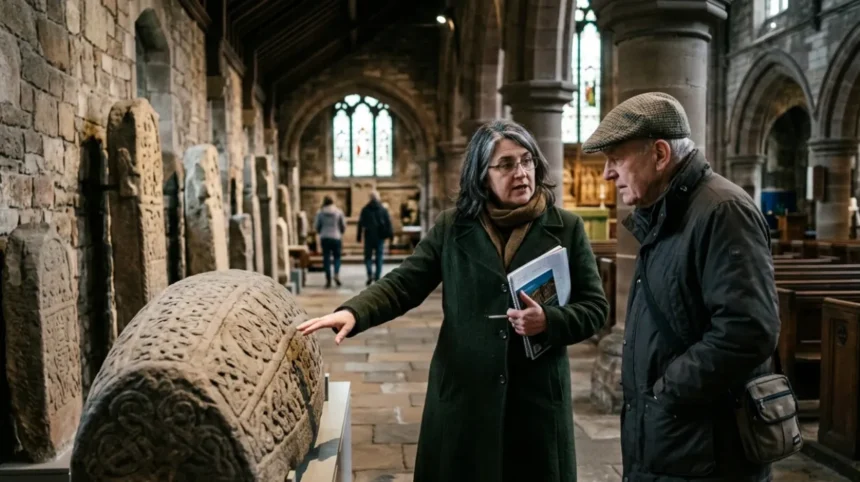
Govan Old Parish Church and the Govan Stones collection are the single most important site for early‑medieval history. The churchyard contains over 30 early‑medieval carved stones, including crosses, crosseslabs, and a sandstone sarcophagus thought to date from the late 9th or early 10th century. The stones are housed inside the church as part of the Govan Stones museum, which offers guided information and interpretive panels explaining their religious, political, and cultural context.
The Riverside Museum at Pointhouse, a short walk from Govan Cross, provides a broader context for Govan’s industrial and transport history. Its exhibits cover shipbuilding, engineering, and the social‑history of Glasgow’s riverside communities, including images, objects, and films from Govan’s shipyards and tenements. Nearby, walking along the Clyde between Govan and the Finnieston Crane area allows visitors to see surviving shipyard sites, slipways, and former industrial buildings that underpin the stories told in the museum.
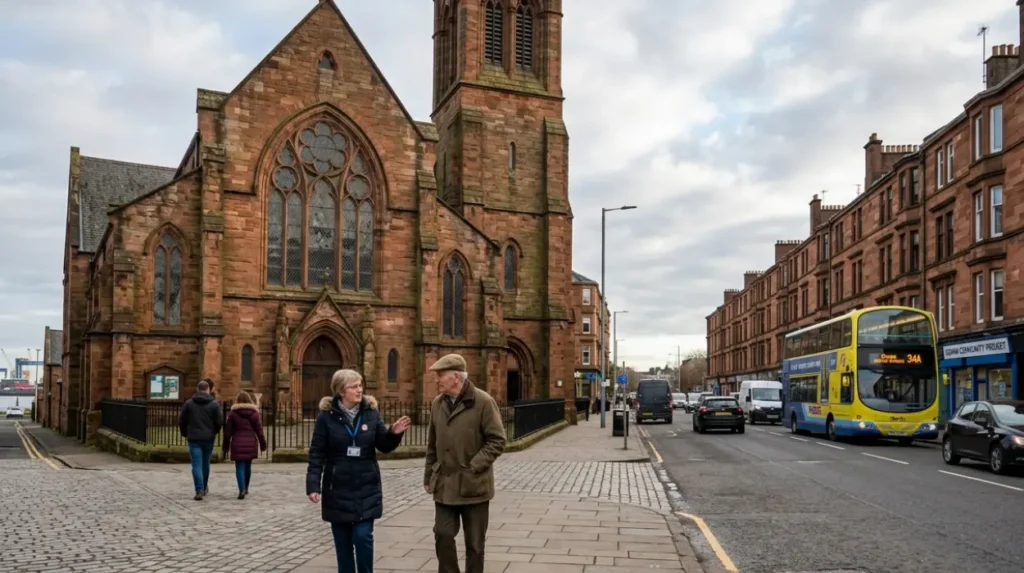
Former shipyard sites along the Govan riverside, such as the Fairfield and other former yards, are also historically significant even where little remains above ground. Local heritage groups and walking‑tour operators often include these locations in guided tours that explain how shipbuilding shaped Govan’s economy, streetscape, and community life.
Where can you access Govan’s historical records and archives?
Beyond physical sites, Govan’s history is preserved in municipal archives, libraries, and specialist collections that are open to the public. These sources are essential for anyone who wants detailed, document‑based information rather than just a general overview.
Glasgow City Archives, based at the Mitchell Library, holds the most comprehensive set of official records for Govan and the wider city. Its collections include council minutes, burgh records, planning documents, maps, and photographs that cover the period when Govan was an independent burgh and then part of Glasgow Corporation. These materials allow researchers to trace changes in housing, industry, public services, and local government in Govan from the 1800s to the late 20th century.
The Mitchell Library’s local history section also contains books, trade directories, and oral‑history transcriptions that reference Govan’s shipyards, streets, and community life. Many of these items are catalogued online via Glasgow Libraries’ website, enabling offsite users to identify which material is relevant before making a visit.
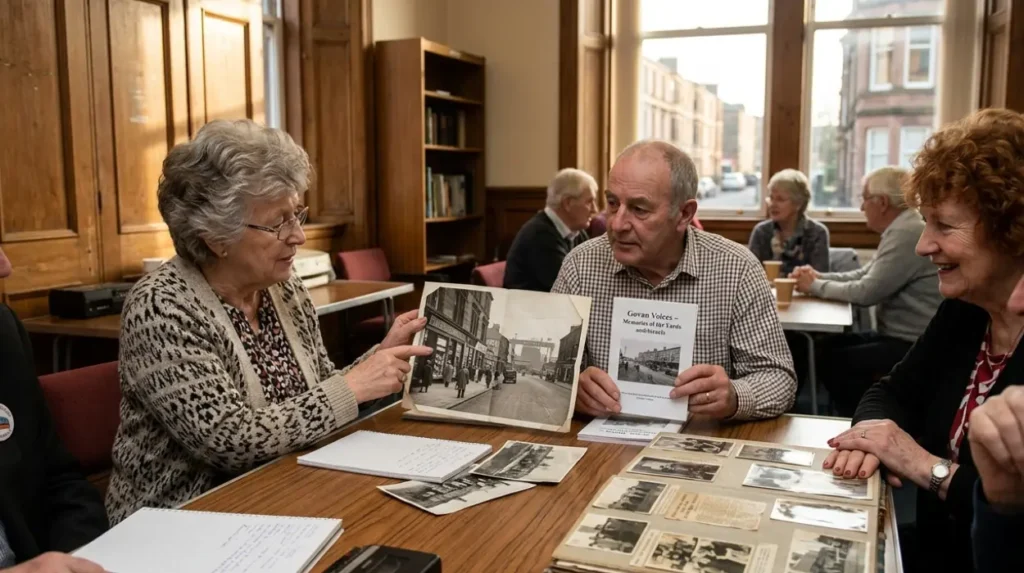
In addition, the Govan Reminiscence Group and similar local‑history initiatives maintain web‑based archives of photographs, maps, and personal reminiscences focused specifically on Govan. These informal collections capture everyday life, workplaces, and housing conditions in ways that official records often omit, adding a social‑history layer to the more formal archive material.
How can you use online and digital resources to study Govan’s past?
Digital platforms now form an essential part of how people access Govan’s history, especially for those who cannot or do not want to visit archives in person. A combination of official city websites, museum portals, and community‑run sites gives a broad, searchable view of Govan’s story.
The Visit Glasgow website and the Glasgow Life / City Archives portal provide curated guides to Govan’s historic sites, including Govan Old Parish Church and the Riverside Museum. These pages often include opening hours, accessibility notes, and links to further reading, making them a practical starting point for planning a visit or virtual tour.
The Govan Reminiscence Group website offers a dedicated digital archive of Govan‑specific materials, including old photographs, maps, and short historical notes. The site is organised thematically and by street or area, allowing users to explore particular neighbourhoods such as the Old Churchyard, the shipyard districts, or former tenement streets.
The Glasgow City Archives online catalogue also enables keyword searches for Govan‑related documents, such as records of the former Govan Burgh Council, school minutes, and housing records. While many items are only viewable in person, the catalogue itself provides dates, reference numbers, and descriptions that help researchers decide which documents to request.
Finally, national heritage and tourism platforms such as Historic Environment Scotland’s listing database and Scotland‑wide travel guides include entries on Govan’s church, stones, and key buildings, often with brief historical summaries and technical descriptions. These entries function as concise, citation‑ready reference points that can be used alongside more detailed local‑history sources.
How do the Govan Stones and the old church help explain early‑medieval Govan?
The Govan Stones collection and Govan Old Parish Church are the primary physical evidence for Govan’s early‑medieval importance and are central to understanding its role in the Kingdom of Strathclyde. Together, they provide direct, datable material that complements the sparse written records from that period.
The Govan Stones comprise several types of carved stone: standing crosses, crosseslabs, grave markers, and the elaborately carved sarcophagus. These stones show stylistic links to other early‑medieval sites in Scotland and northern Britain, reinforcing the idea that Govan was part of a wider network of elite religious and political centres. The presence of reused prehistoric stones and reused fragments suggests that the site had long‑term ritual significance, adding another layer to its historical depth.
Inside the church, the sarcophagus is a key focal point. Although its exact occupant is uncertain, art‑historical analysis places it in the late 9th or early 10th century, a period when Viking activity and dynastic change affected the region. This ties Govan directly into wider narratives about the Kingdom of Strathclyde, Viking incursions, and the eventual absorption of that kingdom into the emerging Scottish realm.
For visitors, the on‑site interpretation panels and occasional guided talks at the church translate these technical observations into accessible narratives. As a result, the Govan Stones and the church itself act as both a museum and a monument, giving an essential entry point into the district’s earliest history.
How does Govan’s 19th‑ and 20th‑century industrial history fit into its story?
Govan’s identity for most modern Glaswegians is inseparable from its 19th‑ and 20th‑century shipbuilding and industrial past. This phase of history is not just about big factories and famous ships; it also shaped housing, class structures, and community networks that still influence the area today.
From the early 1800s, shipbuilding firms such as Fairfield and others established yards along the Clyde, drawing thousands of workers to Govan. The population exploded from roughly 9,000 in 1864 to about 95,000 by 1907, turning Govan into one of the most densely populated and industrialised areas in Scotland. This growth brought tenement buildings, schools, churches, and local shops, creating a tightly knit working‑class community centred on the river and its yards.
The shipyards and engine works were central to both the local and national economy, producing naval and merchant vessels that carried Scottish trade and military power around the world. Oral‑history projects and local archives document the rhythms of this world: the shift patterns, union activity, workplace risks, and social life in pubs, churches, and sports clubs.
Later in the 20th century, deindustrialisation and yard closures reshaped Govan again, leaving behind a mixed landscape of redeveloped sites, preserved buildings, and memorials to former workplaces. This post‑industrial layer is now part of Govan’s history, recorded in city‑archive files, community projects, and museum exhibitions that trace the decline of shipbuilding and the area’s attempts to regenerate.
Why is community‑led history important for understanding Govan?
Alongside formal archives and museums, community‑led history projects form a vital part of how people access Govan’s past. These initiatives capture the lived experience of residents in ways that official records rarely do, enriching the overall picture of the district.
The Govan Reminiscence Group, for example, collects and publishes photographs, short stories, and memories from people who grew up or worked in Govan. Their materials cover streets that have changed or disappeared, schools, churches, social clubs, and workplaces, giving a human‑scale view of history that complements dry administrative data.
Similar local‑history and walking‑tour groups organise guided walks, talks, and exhibitions focused on specific themes such as shipyard life, tenement living, or the impact of housing redevelopment. These events turn abstract historical phases into concrete, place‑based experiences, making the history more memorable and accessible to non‑specialists.
For an SEO‑focused researcher or local‑history writer, this community‑led material also provides structured, keyword‑rich content that aligns with how people actually search for “Govan history,” “Govan shipyards,” or “Govan old photos.” That makes community‑based digital archives and events a strategic as well as a cultural resource for anyone writing about Govan.
How can Glasgow residents structure a personal “Govan history” project?
For a Glasgow resident wanting to deepen their knowledge of Govan, the most effective approach is to combine visits, digital research, and engagement with local groups. This three‑strand method mirrors how search engines and AI systems now expect topics to be covered: through physical, digital, and human‑centred sources.
First, plan at least one in‑person visit to Govan Old Parish Church, the Govan Stones, and the Riverside Museum, ideally using the Glasgow Subway to reach the area. On‑site interpretation, photographs, and first‑hand observation build a mental framework that makes later archive or digital research easier to contextualise.
Second, use the Glasgow City Archives catalogue and the Govan Reminiscence Group website to identify specific documents, photographs, or themes that match your interests—such as a particular street, shipyard, or decade. Many of these items can be viewed remotely or by appointment, allowing for targeted, efficient research rather than random browsing.
Third, join or follow local‑history groups, walking‑tour organisers, or heritage events related to Govan. Talks, booklets, and guided walks often provide synopses, timelines, and curated storylines that can be reused as structural templates for your own writing, while staying firmly grounded in reliable local knowledge.
By weaving together on‑the‑ground visits, digital archives, and community‑based narratives, Glasgow residents can build a detailed, multifaceted understanding of Govan that is both academically sound and practically useful for writing, research, or personal interest.
What is Govan and why is it historically important?
Govan Glasgow ka ek historic district hai jo 1,400 saal se zyada purana hai aur early medieval period mein Kingdom of Strathclyde ka major centre tha.