
Key Points
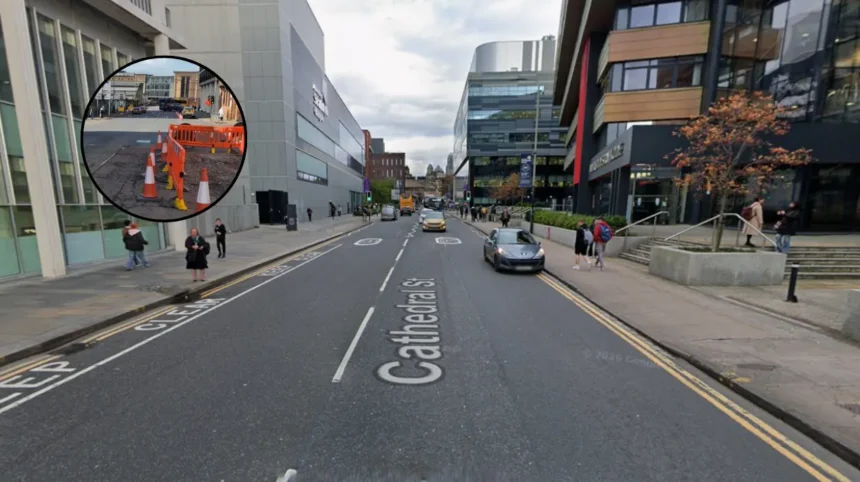
- A busy road in Glasgow city centre, Cathedral Street near its junction with North Hanover Street, has been closed due to signs of potential voids beneath the surface, indicating a likely sewer collapse.
- Scottish Water implemented the emergency closure on Tuesday afternoon, April 1, 2026, prioritising public safety.
- Both sides of the carriageway on Cathedral Street showed surface irregularities suggestive of underground voids.
- An ongoing investigation involves a CCTV inspection of the sewer overnight on Tuesday, followed by ground penetrating radar (GPR) observations on Wednesday morning.
- The affected sewer is a Victorian-era egg brick sewer, which may require immediate repairs depending on findings.
- Scottish Water has advised road users and residents of the closure and is coordinating diversion routes with Glasgow City Council.
- Drivers are urged to follow signage and allow extra time for journeys, as Cathedral Street serves as a key route through the city centre.
- A Scottish Water spokesperson emphasised the necessity of the closure for safety and thanked the public for their patience.
Glasgow (Glasgow Express) April 1, 2026 – Cathedral Street, a vital artery in Glasgow’s bustling city centre, stands closed today following an emergency shutdown by Scottish Water over fears of a sewer collapse beneath the surface. The closure, enacted on Tuesday afternoon near the junction with North Hanover Street, affects both sides of the carriageway where telltale signs of voids have emerged, prompting swift action to avert potential hazards.
- Key Points
- What Triggered the Emergency Closure on Cathedral Street?
- Which Infrastructure Is at Risk in This Incident?
- What Did Scottish Water Officials Say About the Closure?
- How Will the Investigation Unfold Overnight and Beyond?
- What Diversion Routes Are in Place and What Do Drivers Need to Know?
- Why Does This Matter for Glasgow’s City Centre Traffic?
- What Is the History of Sewer Issues in Glasgow?
- How Is Scottish Water Coordinating with Local Authorities?
- What Are the Potential Long-Term Fixes for Victorian Sewers?
- When Can Cathedral Street Reopen?
This development disrupts one of the city’s key thoroughfares, with investigations underway to assess the integrity of a historic Victorian egg brick sewer running underneath. Scottish Water teams are conducting urgent CCTV inspections overnight, set to continue with ground penetrating radar scans on Wednesday morning. The public has been warned to expect delays, as diversion routes are finalised in collaboration with Glasgow City Council.
What Triggered the Emergency Closure on Cathedral Street?
The decision to shutter Cathedral Street stemmed from visible surface anomalies hinting at subsurface instability. As reported by Holly Lennon of STV News, Scottish Water closed the road on Tuesday afternoon after both sides of the carriageway, near North Hanover Street, exhibited
“signs of likely voids beneath the surface.”
This precautionary measure underscores the risks posed by ageing infrastructure in a high-traffic urban zone. Cathedral Street, threading through Glasgow’s vibrant heart, handles substantial daily volumes of vehicles, pedestrians, and public transport, making any disruption keenly felt.
Which Infrastructure Is at Risk in This Incident?
At the core of the issue lies a Victorian egg brick sewer, a relic of 19th-century engineering that has endured over a century of urban strain.
These sewers, characterised by their distinctive egg-shaped brick construction, were designed to facilitate wastewater flow through gravity but are now vulnerable to degradation from ground movement, heavy traffic, and corrosion.
As detailed in the STV News coverage by Holly Lennon, an investigation is ongoing to determine if repairs are needed or if the road can reopen safely. The Victorian infrastructure’s fragility in modern settings is not unique to Glasgow; similar incidents have plagued other UK cities with heritage drainage systems.
What Did Scottish Water Officials Say About the Closure?
A Scottish Water spokesperson provided clear insight into the response strategy. As quoted by Holly Lennon in STV News:
“In the interests of safety, we will be closing the road and carrying out a CCTV inspection overnight, followed by further ground penetrating radar observations tomorrow morning.”
The spokesperson continued: “Depending on what is found a decision will be made on whether the road can be reopened or whether repairs to the Victorian egg brick sewer will be carried out immediately.” Acknowledging the inconvenience, they added:
“We appreciate Cathedral Street is a key route through the city centre, but we have no other option and we would like to thank all those affected for their patience and understanding.”
These statements, drawn directly from Scottish Water’s official communication as relayed by STV News, highlight a methodical approach balancing safety with minimal disruption.
How Will the Investigation Unfold Overnight and Beyond?
The probe kicks off with a CCTV inspection of the sewer network overnight on Tuesday, allowing technicians to visually inspect for cracks, collapses, or blockages without excavating the road.
This non-invasive technique will feed into Wednesday morning’s ground penetrating radar (GPR) surveys, which use electromagnetic waves to map subsurface voids and anomalies.
GPR, a staple in utility investigations, can detect differences in material density up to several metres deep, pinpointing risks without surface disturbance. Should voids confirm a collapse risk, repairs could involve lining the sewer with modern materials or, in severe cases, full replacement—a process that might extend the closure for days or weeks.
Scottish Water’s protocol aligns with standard UK utility practices, ensuring no chances are taken in a densely populated area.
What Diversion Routes Are in Place and What Do Drivers Need to Know?
Glasgow City Council is collaborating with Scottish Water to establish diversion routes, with signage directing traffic promptly. Drivers are advised to follow all posted signs and factor in extra journey time, as Cathedral Street links major districts including the Merchant City, George Square, and routes to the M8 motorway.
Potential rerouting may funnel traffic via nearby streets like High Street, Ingram Street, or George Street, depending on final agreements. Public transport users, including those on Buchanan Bus Station services, face knock-on delays, while cyclists and pedestrians might encounter partial access restrictions.
As per Holly Lennon’s STV News report, Scottish Water is “advising road users and residents of an emergency road closure in Glasgow city centre to investigate a potential sewer collapse,” urging compliance for safety.
Why Does This Matter for Glasgow’s City Centre Traffic?
Cathedral Street’s centrality amplifies the closure’s impact. Flanked by commercial hubs, hotels, and cultural sites like the Glasgow Royal Concert Hall, it funnels commuters, shoppers, and tourists daily. The junction with North Hanover Street serves as a gateway to the financial district and train stations, heightening the stakes.
Past incidents, such as sinkholes on Sauchiehall Street in 2023 or Buchanan Street disruptions, illustrate how sewer woes cascade into broader gridlock. This event risks similar ripple effects, potentially swelling congestion on parallel routes like Union Street or Argyle Street during rush hours.
Local businesses, from cafes to offices, anticipate revenue dips from footfall reductions, echoing complaints from prior utility works.
What Is the History of Sewer Issues in Glasgow?
Glasgow’s subterranean network, much of it Victorian, grapples with chronic challenges. The city’s rapid 19th-century expansion outpaced sewer capacity, leading to frequent collapses under modern loads. Scottish Water has invested billions in upgrades, yet legacy egg brick sewers—narrow, arched channels prized for self-cleansing flow—remain prone to failure.
Comparable closures hit Hope Street in 2024 after a partial collapse, and Bath Street endured months of repairs in 2022. These patterns reflect nationwide trends; a 2025 Water UK report noted over 1,200 UK sewer-related road closures annually, with Scotland bearing a disproportionate share due to its industrial heritage.
Experts attribute vulnerabilities to climate-driven heavy rains exacerbating wear, compounded by urban densification.
How Is Scottish Water Coordinating with Local Authorities?
Collaboration with Glasgow City Council is pivotal for managing diversions and minimising chaos. Council traffic teams are likely deploying temporary signals and variable message signs across the network, drawing on precedents like the 2025 George Square revamp.
Residents and businesses receive updates via council apps and websites, while Transport Scotland monitors M8 interfaces. This joint effort ensures compliance with the Road Traffic Regulation Act 1984, mandating justified emergency closures.
What Are the Potential Long-Term Fixes for Victorian Sewers?
If confirmed, repairs might employ cured-in-place pipe (CIPP) lining, inserting a resin-soaked sleeve that hardens to seal cracks without digging. For extensive damage, slip-lining or microtunnelling could follow, though costlier.
Scottish Water’s £1.5 billion Central Region investment plan targets such assets, prioritising high-risk zones via AI-driven predictive modelling. Long-term, Glasgow eyes sustainable drainage systems (SuDS) to alleviate pressure, integrating green infrastructure like permeable pavements.
When Can Cathedral Street Reopen?
Reopening hinges on inspection outcomes. Benign findings could lift restrictions by Wednesday afternoon; repairs might push this to weekend or beyond. Scottish Water commits to swift resolution, with 24/7 monitoring.
As Holly Lennon reported for STV News on 1 April 2026 at 07:54, the focus remains on safety amid this unfolding saga in Glasgow’s core.