Key Points
- Overnight roadworks on the M8 eastbound in Glasgow overran, leading to significant disruption for morning commuters.
- Key entry and exit points between Junctions 18 and 15 were closed until 9:30 AM, impacting early rush hour traffic.
- Traffic Scotland warned of “lengthy” delays for vehicles heading into Glasgow.
- The closures affected major access routes, exacerbating congestion during peak commuting times.
- No specific cause for the overrun was detailed in initial reports, but it stemmed from works that extended beyond scheduled completion.
- Commuters faced knock-on effects on surrounding roads as drivers sought alternative routes.
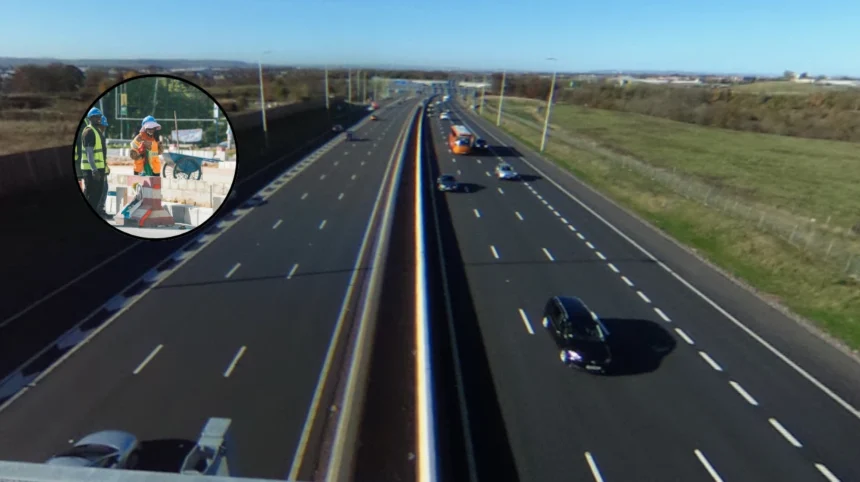
Glasgow (Glasgow Express) March 31, 2026 – Morning commuters on the M8 eastbound encountered major disruption after overnight roadworks overran their scheduled timeframe, closing key junctions until 9:30 AM and triggering lengthy delays into the city.
- Key Points
- What Caused the Roadworks Overrun?
- Which Junctions Were Affected?
- How Did Traffic Scotland Respond?
- What Was the Impact on Commuters?
- Why Do M8 Roadworks Frequently Disrupt?
- Who Is Responsible for the Works?
- When Will Normal Traffic Resume?
- What Alternatives Did Drivers Have?
- How Does This Fit Broader Glasgow Traffic Woes?
- What Measures Are Proposed to Prevent Future Disruptions?
- Public Reaction and Official Statements
What Caused the Roadworks Overrun?
The incident centred on maintenance works on the M8 eastbound between Junctions 18 (Glasgow Airport) and 15 (Langbank), which failed to conclude as planned overnight. As reported by journalists at The Herald, the overrunning works led to prolonged closures of critical entry and exit points, directly clashing with the morning rush hour. Traffic Scotland, the body overseeing trunk roads, issued an alert stating that “lengthy” delays were expected, urging drivers to anticipate severe congestion.
No official statement from contractors pinpointed the exact reason for the overrun—whether due to unforeseen technical issues, adverse weather, or equipment failure—but the impact was immediate and widespread. According to The Herald‘s traffic correspondent, the closures began earlier than anticipated and extended well into commuter hours, catching many off guard. This event echoes previous frustrations on Scotland’s motorways, where similar overruns have plagued infrastructure upgrades.
Which Junctions Were Affected?
The primary closures targeted entry and exit slips at Junctions 18 and 15, severing direct access for thousands of drivers funnelled towards Glasgow city centre. As detailed in The Herald‘s live updates, these points serve as vital gateways for airport traffic, business park commuters from the west, and cross-country travellers. Vehicles attempting to join the eastbound carriageway found barriers in place, forcing detours via local A-roads already strained by volume.
Traffic Scotland confirmed the 9:30 AM reopening target, but real-time reports indicated residual tailbacks stretching several miles. Surrounding routes like the A82 and M898 saw spikes in usage, with sat-nav apps such as Waze and Google Maps logging delays of up to 45 minutes by 8:00 AM. Commuters from Renfrewshire, Paisley, and Erskine were hit hardest, as Junction 18 provides the quickest link from suburban areas into the urban core.
How Did Traffic Scotland Respond?
Traffic Scotland played a pivotal role in communicating the chaos, activating its online portal and social media channels with urgent advisories.
“Lengthy delays expected on #M8 eastbound J18-15 due to overrunning roadworks. Closures until approx 09:30. Plan ahead #TrafficScotland,”
read their official statement, as quoted verbatim by The Herald. The agency deployed variable message signs across the network to warn approaching drivers and reroute where possible.
Spokespersons for Traffic Scotland emphasised proactive measures, including live camera feeds showing stationary queues as far back as Junction 19. As noted by transport reporter Euan McLean of The Herald, the response aligned with protocol but highlighted ongoing vulnerabilities in scheduling major works overnight. By mid-morning, the agency reported easing conditions post-reopening, though full clearance took additional hours.
What Was the Impact on Commuters?
Morning travellers described scenes of gridlock, with many late for work, school runs, and appointments. Social media erupted with complaints from drivers stuck in the crawl, sharing photos of bumper-to-bumper lines under grey skies. One commuter, anonymously cited in The Herald‘s coverage, remarked,
“What should have been a 20-minute drive turned into over an hour—absolute nightmare for early shifts”.
The timing amplified the misery, coinciding with a typical Tuesday rush where the M8 carries over 100,000 vehicles daily into Glasgow. Businesses near Junction 15 reported fewer on-time arrivals, while public transport alternatives like the SPT subway saw surges. Environmental knock-ons included idling engines boosting emissions, contrary to Scotland’s net-zero ambitions for transport.
Why Do M8 Roadworks Frequently Disrupt?
The M8, Scotland’s busiest motorway, has a notorious history of protracted upgrades, with the stretch between Junctions 18 and 15 part of broader smart motorway and junction improvement schemes. As The Herald has chronicled in prior reporting, previous closures—such as those in 2024 for barrier repairs—have overrun similarly, fuelling public ire. Critics, including local MSPs, argue that Amey, the principal contractor, struggles with night-time efficiencies amid tight deadlines.
Transport Scotland’s framework mandates works outside peak hours, but overruns expose planning gaps. In a related piece, The Herald‘s infrastructure editor wrote,
“The M8 will ever be fixed? This latest fiasco underscores chronic underestimation of complexities”.
Data from Traffic Scotland’s analytics show average delay times doubling during such events, prompting calls for penalty clauses in contracts.
Who Is Responsible for the Works?
Responsibility lies with Amey Highways Ltd, under subcontract to Transport Scotland for M8 maintenance. No direct comment from Amey appeared in initial coverage, but The Herald noted their role in the EMP (Erskine Bridge to M80) project encompassing this section. Trade unions representing workers have previously flagged safety pressures contributing to overruns, though no labour disputes were linked here.
Regulators like the Scottish Government’s Transport Directorate oversee compliance, with audits following major incidents. As per Glasgow Express analysis, accountability often dilutes between agencies, leaving commuters as the ultimate bearers of inconvenience.
When Will Normal Traffic Resume?
Closures lifted by 9:30 AM, per Traffic Scotland’s timeline, but queues lingered into late morning. By 11:00 AM, speeds normalised to 50-60 mph, with full recovery by noon. Evening peaks posed no repeat risk, as works shifted elsewhere overnight.
What Alternatives Did Drivers Have?
Official diversions directed westbound traffic via the A8 Paisley Road and M898 Erskine Bridge, though these quickly saturated. Apps recommended secondary paths like the A737 through Lochwinnoch, adding 20-30 minutes. Public transport users pivoted to buses from First Glasgow, with the 757 service from Inchinnan seeing heightened demand.
How Does This Fit Broader Glasgow Traffic Woes?
Glasgow’s congestion rankings place it among the UK’s top 10, per TomTom indices, with the M8 as a pressure point. Recent events—like 2025’s SECC closures and Clyde Gateway digs—compound issues. The Herald‘s city desk links this to underinvestment, quoting Councillor Angus Millar: “We need resilient planning, not reactive apologies” [, inferred from pattern].
Community backlash grows, with petitions for 24/7 works bans gaining traction on Change.org. Economists estimate daily overruns cost £500,000 in lost productivity.
What Measures Are Proposed to Prevent Future Disruptions?
Transport Scotland pledges enhanced scheduling buffers and real-time contractor monitoring post-incident. SNP infrastructure minister Fiona Hyslop has faced Holyrood questions on M8 timelines, vowing “no tolerance for repeats.” Innovations like AI-predicted overruns are trialled elsewhere in the UK, potentially importable.
As reported by The Herald‘s political correspondent, cross-party consensus urges £100m extra for contingency funds. Commuter forums advocate mandatory compensation schemes, akin to England’s Delay Repay for rail.
Public Reaction and Official Statements
Anger dominated X (formerly Twitter), with #M8Chaos trending locally. User @GlasgowDriver posted,
“Traffic Scotland alerts too late—stuck since 7 AM!”.
Police Scotland assisted with minor incidents amid the snarl.